High Frequency PCB Applications
The demand for High Frequency PCB technology continues to grow as modern electronic systems require faster communication speeds, higher accuracy, and improved signal reliability.
Unlike traditional circuit boards, high-frequency PCBs are designed for applications where signal loss, impedance variation, and electromagnetic interference must be carefully controlled.
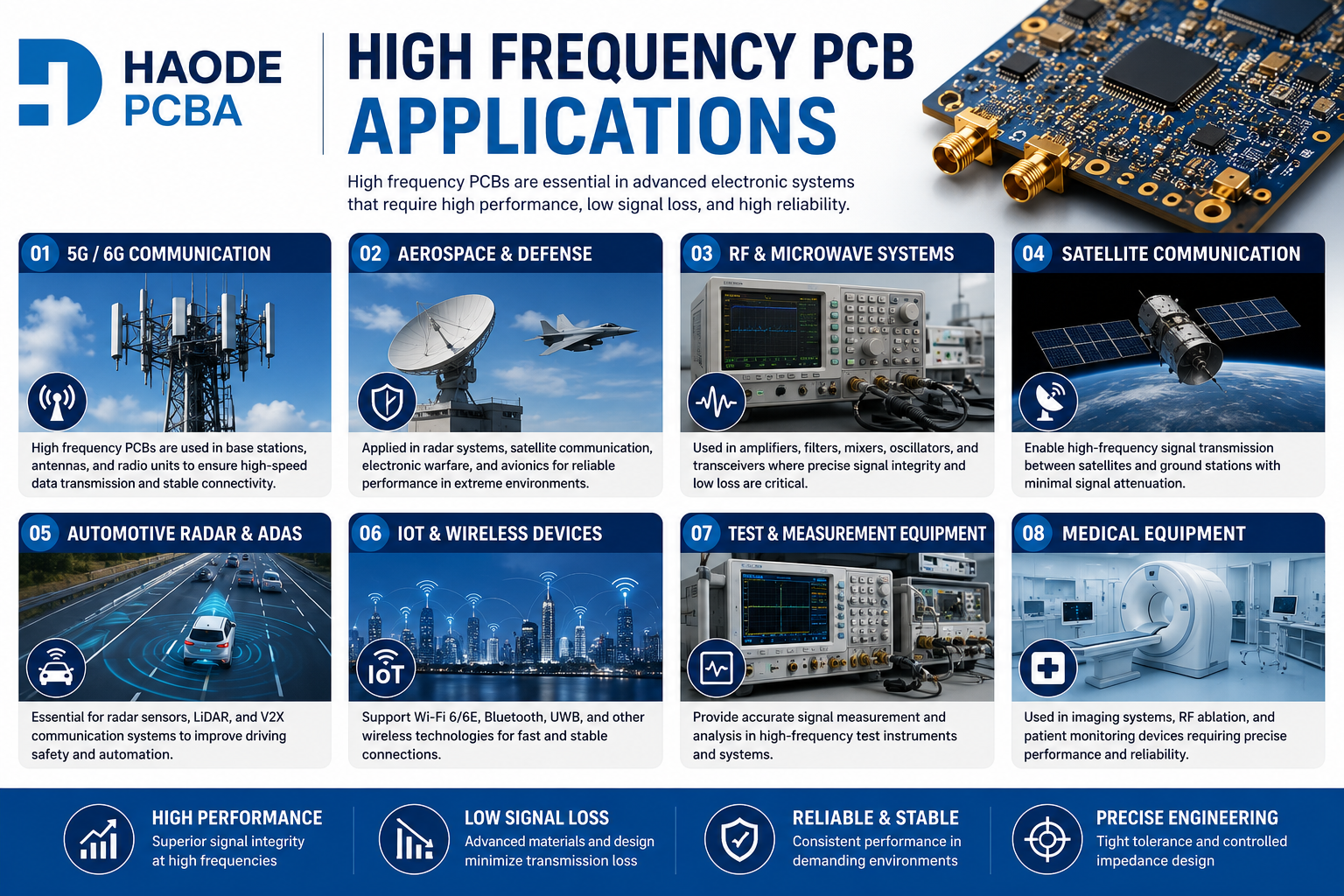
Today, high-frequency PCB technology is widely used in communication, automotive, aerospace, defense, medical, and industrial electronics.
5G Communication High Frequency PCB
5G networks require extremely high data transmission speeds and low latency performance.
Base stations, antennas, and communication modules rely on High Frequency PCB materials to maintain stable RF signal transmission.
Key requirements include:
- Low dielectric loss
- Stable dielectric constant
- High-frequency signal integrity
- Precise impedance control
- Excellent thermal performance
Common applications include:
- 5G base stations
- RF modules
- Antenna systems
- Wireless communication equipment
Advanced low-loss materials such as Rogers and Panasonic high-frequency laminates are commonly selected for these applications.
Automotive Radar High Frequency PCB
Modern vehicles increasingly rely on radar systems for safety and autonomous driving functions.
Automotive radar systems commonly operate at:
- 24 GHz
- 77 GHz
- 79 GHz
At these frequencies, PCB material performance directly affects detection accuracy.
Automotive radar PCBs require:
- Extremely low signal loss
- High dimensional stability
- Reliable performance under temperature changes
- Excellent moisture resistance
Applications include:
- Adaptive cruise control
- Collision avoidance systems
- Blind spot detection
- Autonomous driving sensors
Aerospace And Satellite High Frequency PCB
Aerospace electronics require exceptional reliability because equipment must operate under extreme conditions.
High-frequency PCBs are widely used in:
- Satellite communication
- Navigation systems
- Aircraft communication equipment
- Space electronics
Important requirements include:
- Lightweight construction
- Radiation resistance
- Thermal stability
- Long-term reliability
- Low transmission loss
Advanced RF materials are often selected to maintain consistent performance throughout the product lifecycle.
Medical RF Electronics
Medical devices often require accurate signal transmission and reliable operation.
Applications include:
- Medical imaging equipment
- Wireless monitoring devices
- Diagnostic systems
- RF therapy equipment
High-frequency PCB technology helps improve:
- Signal accuracy
- Device miniaturization
- System stability
Industrial And IoT Applications
The growth of smart manufacturing and connected devices has increased demand for high-frequency circuit technology.
Applications include:
- Industrial wireless systems
- Smart sensors
- Edge computing devices
- IoT gateways
- Automation controllers
These products require compact designs, stable communication, and long operating life.
High Frequency PCB Cost Factors
The cost of a High Frequency PCB is usually higher than standard FR4 PCBs because of specialized materials, advanced processing requirements, and stricter quality control.
Several factors influence the final price.
1. PCB Material Selection
Material is one of the largest cost factors.
Common high-frequency materials include:
- Rogers
- Taconic
- Isola
- Panasonic Megtron
- PTFE-based laminates
Compared with standard FR4, these materials have higher raw material costs due to their advanced electrical properties.
2. Number Of PCB Layers
More layers increase:
- Material consumption
- Manufacturing complexity
- Lamination requirements
- Inspection requirements
A 2-layer RF PCB is usually much cheaper than a complex multilayer high-frequency board.
3. Board Size And Complexity
PCB cost increases with:
- Larger dimensions
- Higher routing density
- Smaller trace spacing
- More vias
- Advanced structures
Complex RF designs require additional engineering and manufacturing control.
4. Controlled Impedance Requirements
High-frequency PCBs often require impedance testing.
Additional costs may include:
- Engineering analysis
- Stackup design
- Test coupons
- TDR impedance testing
However, impedance control is essential for reliable RF performance.
5. Surface Finish
Different surface finishes have different costs.
Common options:
| Surface Finish | Cost Level | Application |
|---|---|---|
| HASL | Low | General Electronics |
| OSP | Medium | Cost-sensitive Products |
| ENIG | Higher | Fine Pitch & RF Applications |
| Immersion Silver | Higher | High Performance RF |
6. Production Quantity
Like other PCB products, quantity affects unit price.
Small quantities usually have higher costs because:
- Setup costs are distributed across fewer boards
- Engineering time is higher
- Material purchasing efficiency is lower
Large-volume production benefits from:
- Better material utilization
- Optimized processes
- Lower manufacturing cost
How To Reduce High Frequency PCB Cost
Although high-frequency PCBs require advanced technology, manufacturers can reduce costs through proper planning.
Optimize Material Selection
Not every application requires the most expensive laminate.
Engineers should balance:
- Frequency requirement
- Signal loss requirement
- Reliability target
- Budget
Complete DFM Review Early
A professional DFM review can identify:
- Manufacturing risks
- Unnecessary complexity
- Cost-saving opportunities
Early optimization prevents expensive redesigns.
Select The Right Layer Count
More layers do not always mean better performance.
A properly designed stackup can achieve performance targets with fewer layers.
Work With An Experienced Manufacturer
An experienced High Frequency PCB Manufacturer can help:
- Select suitable materials
- Optimize stackup
- Improve yield
- Reduce production risks
- Shorten development cycles
Rogers PCB Vs FR4 PCB Comparison
| Feature | Rogers PCB | FR4 PCB |
| Frequency Performance | Excellent | Limited |
| Dielectric Stability | Excellent | Moderate |
| Signal Loss | Very Low | Higher |
| Cost | Higher | Lower |
| RF Application | Excellent | Limited |
| Manufacturing Difficulty | Higher | Easier |
FR4 remains suitable for general electronics, while Rogers and other advanced laminates are preferred for demanding RF applications.
How To Choose A High Frequency PCB Manufacturer
Selecting the right supplier is critical for project success.
A qualified manufacturer should provide:
Material Expertise
The supplier should understand:
- Rogers materials
- PTFE laminates
- Low-loss materials
- High-speed materials
Engineering Support
Professional PCB manufacturers should provide:
- Stackup recommendations
- DFM analysis
- Impedance simulation
- Manufacturing suggestions
Quality Control Capability
Important quality systems include:
- AOI inspection
- Electrical testing
- Impedance testing
- Microsection analysis
- Material traceability
PCB Assembly Capability
Choosing a supplier with both PCB fabrication and assembly capability simplifies production.
Benefits include:
- Single supplier management
- Faster communication
- Reduced logistics cost
- Better production control
Frequently Asked Questions About High Frequency PCB
What Is A High Frequency PCB?
A High Frequency PCB is a circuit board designed for RF, microwave, and high-speed applications using specialized low-loss materials.
What Frequency Requires A High Frequency PCB?
Generally, applications above several hundred megahertz may require high-frequency PCB materials, especially when signal integrity becomes critical.
Is FR4 Suitable For High Frequency PCB?
Standard FR4 works for many applications but may not provide sufficient performance for demanding RF and microwave designs.
Which Materials Are Used For High Frequency PCB?
Common materials include Rogers, Taconic, Isola, Panasonic Megtron, PTFE, and other low-loss laminates.
Why Are High Frequency PCBs More Expensive?
They require advanced materials, tighter manufacturing tolerances, controlled impedance processes, and additional testing.
What Is The Best Material For RF PCB?
The best material depends on frequency, loss requirements, temperature conditions, and application environment.
What Is The Difference Between RF PCB And High Frequency PCB?
RF PCB usually refers to boards designed for radio frequency circuits, while High Frequency PCB covers a broader range including microwave and high-speed applications.
Can Haode PCBA Manufacture High Frequency PCB?
Yes. Haode PCBA provides PCB fabrication and PCB assembly services with engineering support, material sourcing, impedance control, inspection, and customized manufacturing solutions.
Why Choose Haode PCBA For High Frequency PCB Manufacturing
Haode PCBA provides professional High Frequency PCB Manufacturing solutions for global customers requiring reliable RF and high-speed circuit boards.
Our capabilities include:
✓ High-frequency material sourcing
✓ Custom PCB fabrication
✓ Multilayer PCB production
✓ Controlled impedance manufacturing
✓ SMT and through-hole assembly
✓ Component sourcing
✓ AOI inspection
✓ Electrical testing
✓ Prototype and mass production support
With experienced engineers and strict quality management, Haode PCBA helps customers transform advanced electronic designs into reliable finished products.
Get Your High Frequency PCB Quote Today
Looking for a reliable High Frequency PCB Manufacturer?