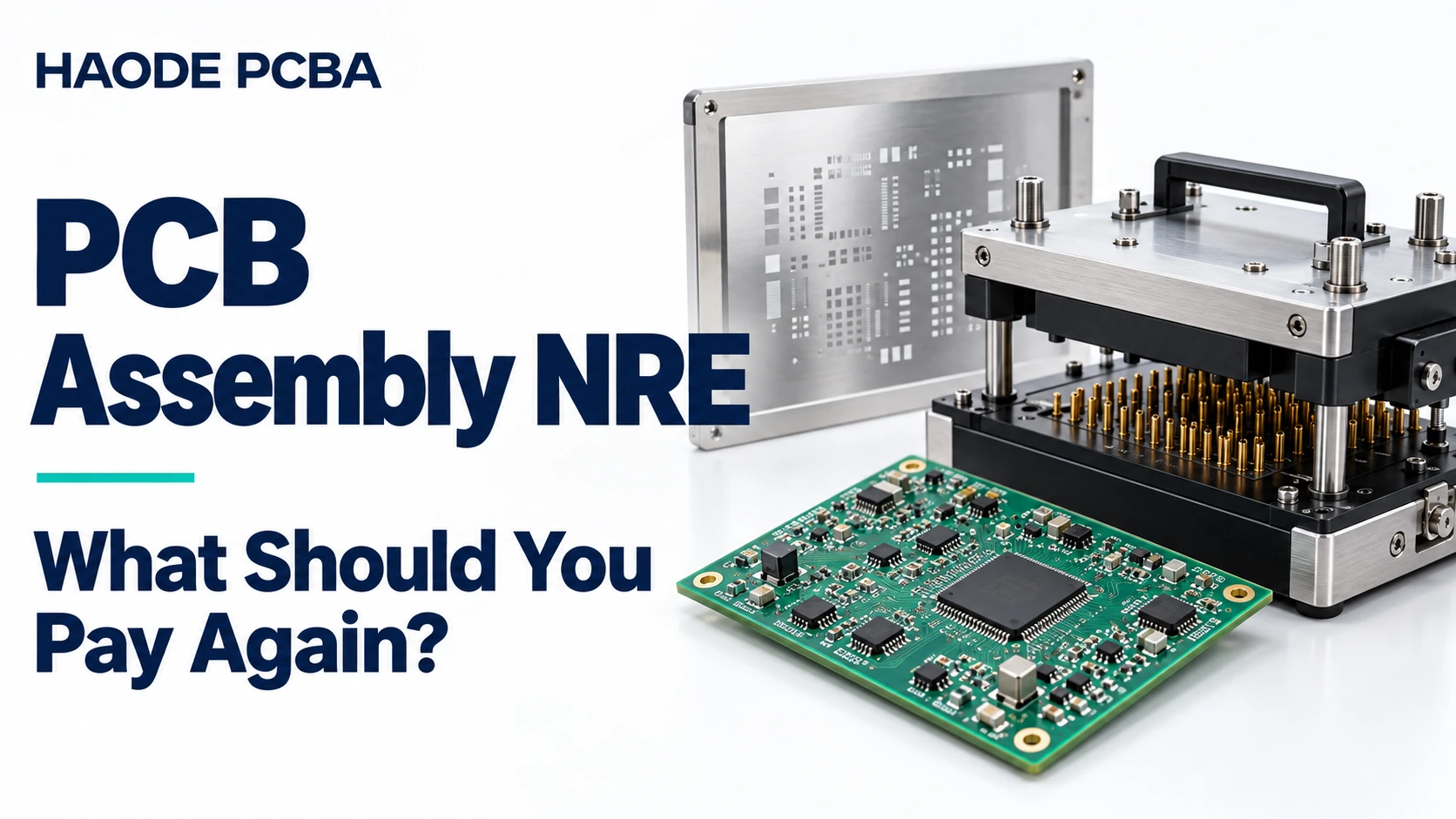
PCB assembly NRE means non-recurring engineering: the initial work required to prepare a particular assembly for production. Depending on the quotation, it may cover engineering review, stencil preparation, fixture development or programming setup. Repeat orders can still carry production setup charges, while design changes may require additional engineering.
The buyer’s practical question is simple: “We already paid for the first build. Which charges should disappear, which can return, and what work would justify a new fee?”
Answer that by linking each charge to a deliverable, an approved revision and a reuse condition. An invoice line labelled “NRE” provides too little detail on its own.
What Does PCB Assembly NRE Cover?
MacroFab’s electronics glossary describes NRE as the initial engineering and preparation expenses associated with bringing a PCBA design to production readiness. Individual quotations can group that work differently.
Ask your supplier to identify what the quoted fee produces.
| Possible Charge | Deliverable To Identify | Reuse Question |
|---|---|---|
| Manufacturing engineering | Reviewed build instructions and resolved manufacturing issues | Does the approved build remain unchanged? |
| Stencil preparation | Identified stencil and approved paste-aperture data | Does it still match the board, panel and printing requirements? |
| Placement-program preparation | Released program for the intended equipment and assembly configuration | Can the factory reuse it on the scheduled line? |
| Programming setup | Device configuration, programming sequence and verification method | Are the target device and approved image requirements unchanged? |
| Test development | Fixture, test software, procedure and acceptance limits | Does the current product still match the validated setup? |
The quotation should also state what remains outside the fee. For example, developing a test application may exclude purchasing the instruments it requires.
If two suppliers both quote “test NRE,” compare the outputs. One may provide a simple operator-guided check, while the other develops automated measurements and individual board records.
PCB Assembly NRE Vs Setup Fees: What Can Repeat?
Separate initial development from the activities needed to start each production run.
An engineer may develop the placement program once. On a later run, production staff may still load feeders, retrieve the program, verify component assignments and confirm the setup before releasing the line.
Similarly, an existing test fixture may remain usable while the team checks its contacts, reference results and current software configuration.
Those activities can support a recurring setup charge if the quotation includes one. They do not automatically establish a need to develop the same assets again.
Ask the supplier to use three clear categories:
- Initial development: Work that creates the approved manufacturing or test method.
- Per-run preparation: Work performed each time the factory starts a separate production run.
- Change work: Modifications and verification needed after an identified change.
Keep per-board assembly, programming and testing charges visible alongside these categories. The PCB assembly cost breakdown helps organize the complete price.
Does A Repeat Purchase Order Mean One Production Run?
Ask how the factory defines a run. One purchase order with four delivery dates might involve one completed build held for shipment, or four separate production setups.
Those arrangements can produce different setup, storage and inventory costs. Confirm the planned manufacturing releases before calculating how often the setup fee applies.
What Should Disappear From An Unchanged Repeat Order?
If the supplier can reuse the approved assets and the agreed pricing excludes further development, the repeat quotation should reflect that reuse.
“Unchanged” needs a clear reference. Compare the board revision, component requirements, panel arrangement, programming configuration and test specification with the previous approved build.
For each returning NRE line, ask:
Which existing deliverable cannot be reused, what changed, and what work will the new charge produce?
A useful answer might identify an unavailable fixture, a changed test interface or a replacement stencil after documented damage. A repeated fee description without that explanation leaves the buyer unable to assess the charge.
Also ask whether the fee covers repair, verification or complete redevelopment. Those are different scopes and should appear that way in the estimate.
Reuse does not remove the need for routine production checks. It should remove unnecessary duplication of work already completed and still suitable for the order.
A Worked Example: First Build, Repeat Build And Revision Change
Consider the following illustrative quotation. These amounts explain the billing structure; they are not market benchmarks or Haode prices.
| Preparation Item | First Build | Unchanged Repeat | Approved Revision Change |
|---|---|---|---|
| Initial manufacturing-data preparation | $180 | $0 | $60 for a defined update |
| Stencil | $120 | $0 if reusable | $120 if replacement is required |
| Test-fixture and software development | $600 | $0 if reusable | $200 for an agreed modification |
| Per-run setup | $150 | $150 | $150 |
| Preparation total | $1,050 | $150 | $530 |
Components, bare boards, per-board processing and freight remain outside this example.
The unchanged repeat saves $900 in initial preparation. It still includes the agreed $150 run setup.
The revision-change column assumes engineering has established the stated work. A board revision does not automatically trigger every fee. For example, a documentation change may leave the physical stencil and fixture unaffected.
Request the same explanation for your actual project. A change quotation should identify the affected assets and the evidence required to approve their updated versions.
When Does A New PCB Revision Need A New Stencil?
Review the approved printing data and process requirements. A revision letter alone does not determine stencil reuse.
Changes to pad locations, paste openings, panel layout or printing requirements can make an existing stencil unsuitable. A silkscreen-only change may leave the paste pattern unchanged, although the team still needs to confirm the relevant files.
Eurocircuits’ production and solder-paste file guidance recommends reviewing paste data before using it to produce a stencil and discusses its relationship to the assembly panel.
Therefore, compare the actual paste and panel data before approving a replacement charge.
For a reusable stencil, record its identifier, compatible board/panel revision and condition. If the supplier proposes replacement because of wear or damage, request the inspection finding and proposed replacement scope.
The PCB stencil overview explains the printing role; the purchasing decision here is whether the existing identified tool remains suitable for the approved build.
Can Firmware Changes Create New PCB Assembly NRE?
They can create additional work, even when the bare board remains identical. The amount depends on what changes in programming and acceptance testing.
A simple approved-image update may require controlled file replacement and verification. A new processor, memory map, security configuration or serialization scheme may require a broader programming review.
Ask the supplier to distinguish:
| Change | Work To Assess |
|---|---|
| New firmware image with the same programming requirements | Update the released image and verify the programming result |
| Changed bootloader or memory allocation | Review image layout, target settings and programming sequence |
| New device-specific identifiers | Review allocation, uniqueness checks and result recording |
| Changed security or protection settings | Review the approved sequence, verification access and recovery implications |
| Changed product behavior | Update affected functional tests and expected results |
For example, the SEGGER J-Flash manual distinguishes project settings from programming data and describes verification options. For a station using that tool, the approved setup involves more than the binary file.
Avoid calling all of this “programming” on the invoice. Distinguish developing the method, changing the method, preparing the station and programming each production board.
Define the related PCBA functional testing requirements so a software change receives the appropriate acceptance checks.
What Should A Test-Fixture Development Fee Deliver?
Define completion before authorizing development. A fixture that physically holds the board represents only part of a working test system.
Request a deliverables list covering the fixture identifier, supported board revision, interfaces, required instruments, test software, operator instructions, limits and result format.
Then define acceptance evidence. Depending on the product, this may include:
- Demonstrating the agreed sequence on approved reference boards.
- Recording measurements under the specified supply and load conditions.
- Checking selected rejection conditions using safe, approved methods.
- Recording the software and fixture revisions used for the demonstration.
A passing reference board alone does not establish every intended failure-detection capability. Select acceptance checks around the risks the fixture must address.
Agree what documentation and software formats the development fee includes. An executable application, editable source project and wiring drawing provide different possibilities for future maintenance.
If a small layout change could make the fixture unusable, a design-for-testability review can address access and interface questions before the next revision reaches production.
Does Paying NRE Mean You Can Take The Tooling To Another Factory?
Confirm that arrangement explicitly before ordering. The fee description alone does not tell you what the supplier will release.
Ask separately about:
| Item | Confirmation To Request |
|---|---|
| Physical tools | Ownership, custody and the procedure for requesting return |
| Production files | Which files the supplier will provide and in what format |
| Test software | Whether delivery includes an executable, source project or both |
| Third-party software | Required licenses and permitted use at another site |
| Retention | How long the supplier keeps tools and records between orders |
| Transfer work | Packing, documentation, adaptation and verification charges |
For example, receiving a physical fixture does not guarantee the next factory has the instruments, drivers and software permissions needed to operate it.
Likewise, a placement program prepared for one machine platform may need adaptation elsewhere. Transferability and repeat use at the original supplier are different questions.
Use these confirmations to establish a practical handover package. Do not wait until a supplier change to discover that the files you expected were never part of the quoted deliverables.
How To Review A New PCB Assembly NRE Charge
Start with the previous quotation and its approved outputs. Ask the supplier to identify the new work against that baseline.
A concise change estimate should state the reason, affected deliverable, planned work, acceptance evidence, cost and schedule effect. It should also identify assets that remain usable.
If the supplier identifies a late customer change, establish when the original work began and which completed work the change affects. That makes the additional scope easier to review.
If the supplier changes its own equipment or process, ask why adaptation is necessary and how the agreed commercial terms handle it. Avoid assuming that every internal change either belongs on your invoice or must be free.
Resolve the estimate before authorizing the additional work. Keep the approved change with the manufacturing release so purchasing and production use the same baseline.
This belongs within the PCBA new product introduction process, especially when prototype changes continue during preparation.
What To Include In Your Next NRE Quote Request
Compare PCB assembly NRE by requesting a first-build price and an unchanged-repeat price using the same quantity and acceptance scope. This makes the reuse assumptions visible.
You can adapt the following request:
Please separate initial engineering, reusable tooling, per-run setup and per-board charges. For each NRE item, identify the deliverable, supported revision, acceptance evidence and reuse conditions. Show the cost of an unchanged repeat order and explain what changes require a new estimate. Please also confirm tool retention, file availability and any transfer-related conditions.
For an enquiry to Haode PCBA, provide the current design files, BOM, programming/test requirements and any existing tools or approved production records. If you expect revisions, describe what remains open before requesting a firm development scope.
A useful PCB assembly NRE agreement makes future orders predictable: both teams know what the first fee creates, what they can reuse, and which changes require new work.