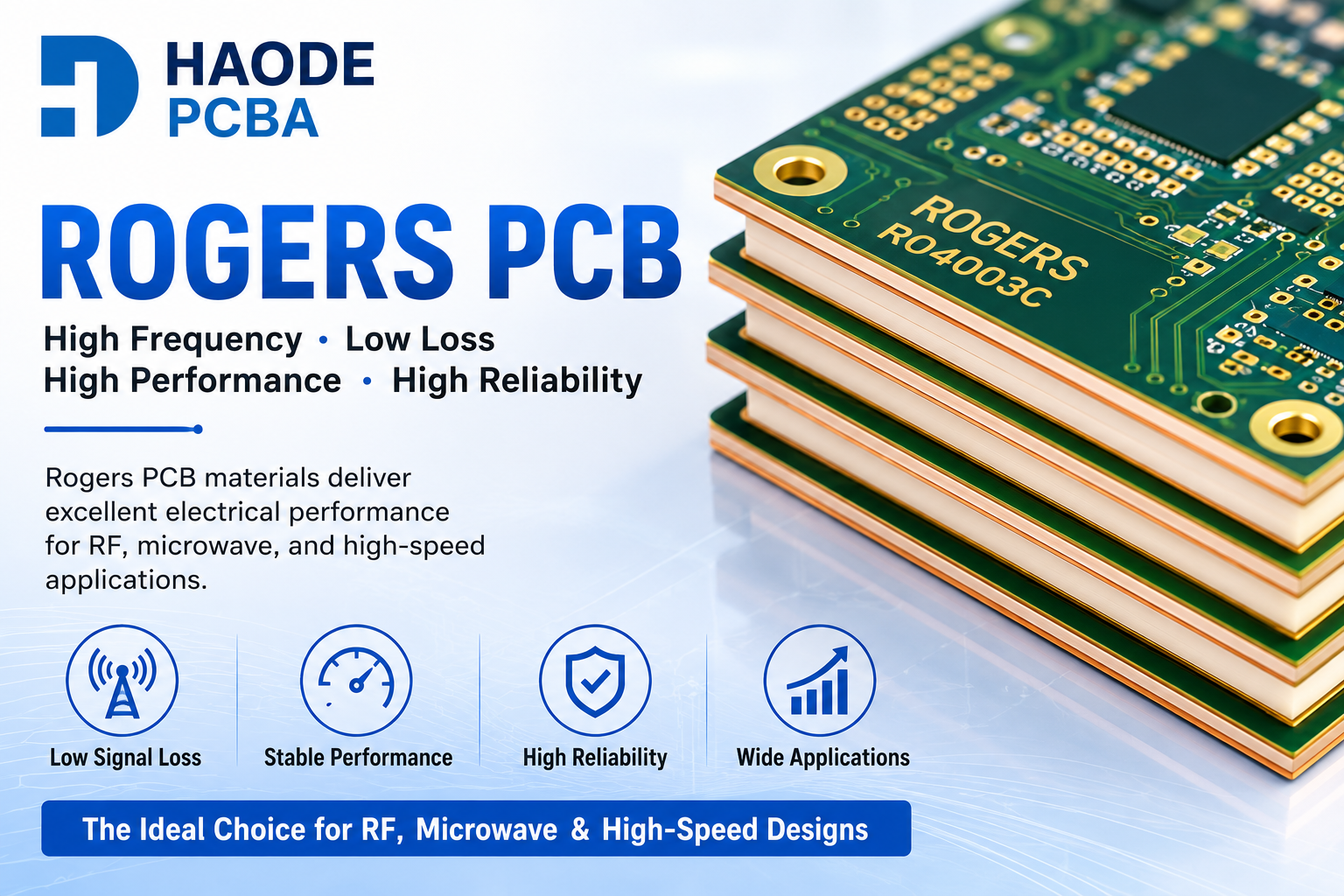
Rogers PCB: The Complete Guide To High-Performance RF Circuit Boards
If your product operates at high frequencies, standard FR-4 may no longer provide the electrical performance required for stable signal transmission. A Rogers PCB is engineered with advanced low-loss laminate materials that deliver superior dielectric stability, lower insertion loss, and precise impedance control for RF, microwave, millimeter-wave, and high-speed digital applications.
From 5G base stations and automotive radar to aerospace communication and satellite systems, Rogers materials have become the preferred choice for engineers who require consistent performance in demanding environments. Understanding the differences between Rogers laminates and conventional PCB materials helps improve signal integrity, reduce design risks, and optimize manufacturing reliability.
Quick Answer
A Rogers PCB is a printed circuit board manufactured with Rogers high-performance laminate materials instead of traditional FR-4. These materials provide a stable dielectric constant (Dk), low dissipation factor (Df), excellent thermal stability, and superior impedance consistency, making them ideal for RF, microwave, high-speed digital, aerospace, automotive radar, and telecommunications applications.
Key Takeaways
- Designed for RF and microwave circuits
- Lower insertion loss than FR-4
- Stable dielectric constant across wide frequency ranges
- Excellent impedance control
- High thermal reliability
- Suitable for multilayer and hybrid stackups
- Widely used in 5G, radar, aerospace, satellite, and medical electronics
What Is A Rogers PCB?
A Rogers PCB is a circuit board fabricated using laminate materials developed by Rogers Corporation. Unlike standard epoxy glass FR-4 substrates, Rogers materials are specifically formulated to maintain stable electrical properties under high-frequency conditions.
As operating frequencies increase into the gigahertz range, signal quality becomes increasingly sensitive to dielectric variation and material loss. Rogers laminates are engineered to minimize these effects, enabling reliable transmission of RF and microwave signals with minimal attenuation.
Depending on the application, Rogers materials may be used for the entire PCB or combined with FR-4 in a hybrid stackup to balance performance and cost.
Why Engineers Choose Rogers PCB
Material selection directly influences the performance of high-frequency electronic products. Rogers laminates offer several advantages that standard PCB materials cannot consistently achieve.
Stable Dielectric Constant
The dielectric constant remains highly consistent across a wide frequency range, simplifying impedance calculations and improving signal timing.
Low Dissipation Factor
A low Df reduces signal attenuation, allowing RF energy to travel longer distances with minimal loss.
Excellent Thermal Stability
Rogers materials maintain their electrical performance under elevated temperatures, making them suitable for harsh industrial and automotive environments.
Superior Dimensional Stability
Low thermal expansion helps maintain layer alignment and impedance consistency during manufacturing and long-term operation.
Low Moisture Absorption
Reduced moisture uptake prevents changes in electrical characteristics in humid operating environments.
Rogers PCB Vs FR-4
Although FR-4 remains the most widely used PCB substrate, it was not originally developed for microwave frequencies.
| Feature | Rogers PCB | Standard FR-4 |
|---|---|---|
| Frequency Performance | Excellent | Moderate |
| Dielectric Stability | Excellent | Varies By Manufacturer |
| Dissipation Factor | Very Low | Higher |
| Controlled Impedance | Excellent | Moderate |
| Thermal Stability | Excellent | Good |
| Moisture Resistance | Excellent | Moderate |
| Manufacturing Cost | Higher | Lower |
For low-speed consumer electronics, FR-4 is usually sufficient. However, RF systems operating at several gigahertz often require Rogers laminates to achieve the desired signal integrity.
Rogers Material Families
Rogers Corporation offers multiple laminate families designed for different electrical and mechanical requirements.
Choosing the correct material depends on operating frequency, thermal requirements, manufacturing process, and budget.
The most commonly used Rogers materials include:
- RO4350B
- RO4003C
- RT/duroid 5880
- RO3003
- RO3010
- RO4835T
- CLTE Series
Each material has unique dielectric properties and application advantages.
Rogers RO4350B
RO4350B is one of the most widely used Rogers materials for commercial RF applications.
Key characteristics include:
- Stable dielectric constant
- Low loss
- Good thermal conductivity
- Compatible with conventional FR-4 processing
- Excellent dimensional stability
Typical applications include:
- 5G communication equipment
- RF amplifiers
- Power dividers
- Automotive radar
- Wireless infrastructure
Its compatibility with standard PCB manufacturing processes makes RO4350B one of the most cost-effective high-frequency materials available.
Rogers RO4003C
RO4003C provides excellent electrical performance while offering easier processing than many PTFE-based materials.
Advantages include:
- Low dielectric loss
- Stable impedance
- Good mechanical strength
- Reliable multilayer lamination
- Competitive manufacturing cost
Common applications:
- Satellite communication
- GPS modules
- RF transceivers
- Industrial wireless systems
RO4003C is often selected when engineers require predictable RF performance without the manufacturing complexity associated with PTFE laminates.
RT/duroid 5880
RT/duroid 5880 is one of the highest-performance laminate materials available for microwave and millimeter-wave circuits.
Major benefits include:
- Ultra-low dielectric constant
- Extremely low loss tangent
- Outstanding signal transmission
- Excellent high-frequency stability
Typical applications include:
- Aerospace electronics
- Satellite antennas
- Military communication
- Millimeter-wave radar
- Scientific instrumentation
Because of its exceptional electrical properties, RT/duroid 5880 is frequently used in designs where signal loss must be minimized over long RF transmission paths.
Which Rogers Material Should You Choose?
There is no single Rogers laminate suitable for every project. Material selection depends on balancing electrical performance, manufacturability, and overall project cost.
As a general guideline:
- RO4350B – Best balance of performance and cost for commercial RF products.
- RO4003C – Excellent choice for wireless communication and multilayer RF designs.
- RT/duroid 5880 – Preferred for microwave, aerospace, and ultra-low-loss applications.
- RO3003 – Suitable for precision phase-sensitive circuits.
- RO3010 – Ideal for compact antenna and microwave components requiring a higher dielectric constant.