Introduction
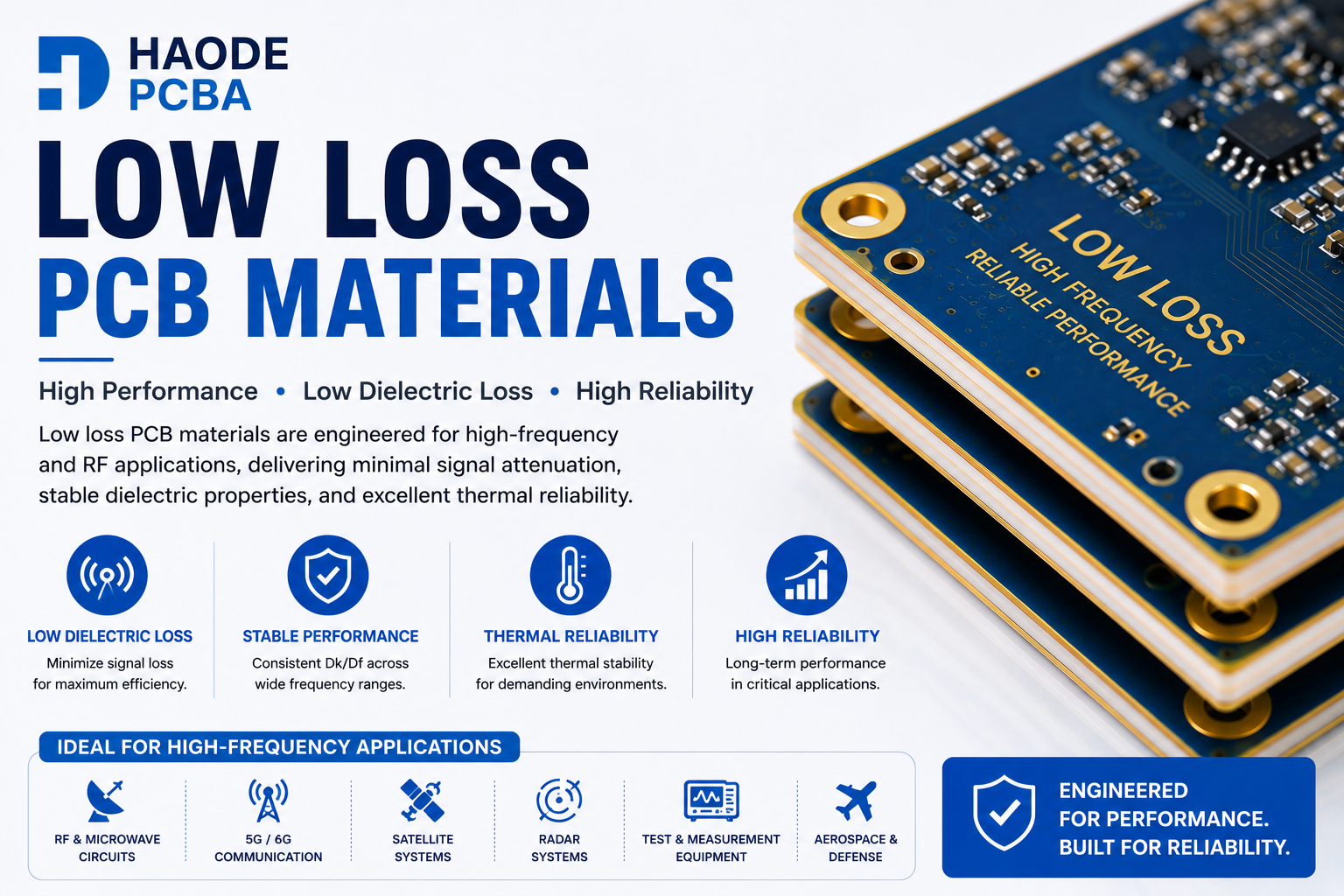
Low Loss PCB Materials are essential for modern electronic systems that require high-speed signal transmission, minimal attenuation, and excellent signal integrity. As communication frequencies continue to increase, traditional FR4 materials may introduce excessive signal loss, making advanced low-loss laminates necessary for demanding applications.
Low-loss PCB materials are widely used in RF systems, microwave circuits, 5G communication equipment, automotive radar, aerospace electronics, satellite communication, and high-speed digital products.
Choosing the correct PCB substrate directly affects transmission efficiency, impedance control, thermal reliability, and overall product performance.
Quick Answer
Low Loss PCB Materials are specialized PCB substrates designed to minimize signal attenuation during high-frequency transmission. They typically feature low dielectric loss (Df), stable dielectric constant (Dk), and excellent electrical performance. Common low-loss materials include Rogers laminates, PTFE-based materials, Panasonic Megtron, Isola high-speed materials, and other advanced high-frequency substrates.
What Are Low Loss PCB Materials?
Low-loss PCB materials are advanced laminate materials engineered to reduce energy loss when electrical signals travel through PCB traces.
In traditional PCB materials, part of the signal energy is converted into heat due to dielectric loss. As frequency increases, this loss becomes more significant and can negatively affect system performance.
Low-loss materials help reduce:
- Signal attenuation
- Insertion loss
- Phase distortion
- Transmission errors
- RF performance degradation
These characteristics make them critical for high-frequency and high-speed electronic designs.
Why Signal Loss Matters In PCB Design
At low frequencies, signal loss may have little impact. However, modern systems operate at much higher frequencies where even small losses can affect performance.
High signal loss may cause:
- Reduced communication distance
- Lower antenna efficiency
- Increased power consumption
- Poor signal quality
- Data transmission errors
For example:
A 5G antenna system operating at millimeter-wave frequencies requires much stricter material control than a simple control circuit.
Key Properties Of Low Loss PCB Materials
Low Dissipation Factor (Df)
The dissipation factor represents how much electrical energy is lost inside the dielectric material.
A lower Df provides:
- Lower signal attenuation
- Better transmission efficiency
- Improved RF performance
This is one of the most important parameters when selecting high-frequency PCB materials.
Stable Dielectric Constant (Dk)
The dielectric constant affects:
- Signal propagation speed
- Impedance calculation
- Circuit dimensions
Stable Dk values help engineers achieve:
- Accurate simulation results
- Reliable impedance control
- Consistent production quality
Low Moisture Absorption
Moisture can change dielectric properties and affect signal performance.
Low-loss materials typically provide:
- Better environmental stability
- More predictable electrical behavior
- Improved reliability
Thermal Stability
Advanced PCB materials must maintain performance under temperature changes.
Important characteristics include:
- Low thermal expansion
- Good dimensional stability
- Reliable mechanical strength
Common Low Loss PCB Materials
Rogers PCB Materials
Rogers is one of the most widely recognized manufacturers of low-loss PCB laminates.
Popular materials include:
Rogers RO4350B
RO4350B provides an excellent balance between electrical performance and manufacturing convenience.
Advantages:
- Low dielectric loss
- Stable Dk
- FR4-compatible processing
Applications:
- RF amplifiers
- Wireless communication
- Automotive radar
Rogers RO4003C
RO4003C offers reliable high-frequency performance with excellent dimensional stability.
Applications:
- GPS systems
- Communication modules
- RF circuits
Rogers RT5880
RT5880 is designed for ultra-low-loss microwave applications.
Advantages:
- Extremely low Df
- Excellent frequency stability
Applications:
- Satellite communication
- Radar systems
- Aerospace electronics
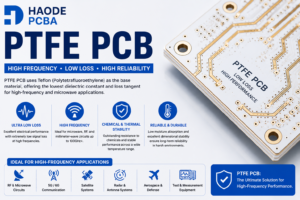
PTFE PCB Materials
PTFE-based laminates provide outstanding microwave performance.
Advantages:
- Very low dielectric loss
- Excellent electrical properties
- High-frequency stability
Applications:
- Microwave circuits
- Defense electronics
- Space communication
However, PTFE materials require more specialized PCB manufacturing processes.
Panasonic Megtron Materials
Panasonic Megtron materials are commonly used in high-speed digital applications.
Applications include:
- Data centers
- AI servers
- High-speed networking equipment
Advantages:
- Low transmission loss
- Excellent signal integrity
Isola High-Speed Materials
Isola provides advanced low-loss materials for communication and networking systems.
Common applications:
- High-speed computing
- Network equipment
- Industrial electronics
Low Loss PCB Materials Vs FR4
| Feature | Low Loss PCB Materials | FR4 PCB |
|---|---|---|
| Signal Loss | Very Low | Higher |
| Frequency Performance | Excellent | Limited |
| Dielectric Stability | High | Moderate |
| Cost | Higher | Lower |
| RF Applications | Excellent | Limited |
| Manufacturing | More Complex | Easier |
Applications Of Low Loss PCB Materials
5G Communication
Used in:
- Base stations
- Antenna modules
- RF equipment
Automotive Radar
Used in:
- 24GHz radar
- 77GHz radar
- Autonomous driving systems
Aerospace And Satellite
Used in:
- Satellite communication
- Navigation systems
- Space electronics
Microwave Systems
Used in:
- Microwave filters
- Amplifiers
- RF modules
High-Speed Digital Electronics
Used in:
- Servers
- Data centers
- Advanced computing systems
How To Select The Right Low Loss PCB Material
Material selection should consider:
Operating Frequency
Higher frequencies usually require lower-loss materials.
Signal Loss Requirements
Evaluate:
- Insertion loss
- Transmission distance
- Power efficiency
Thermal Environment
Consider:
- Operating temperature
- Heat generation
- Reliability requirements
Manufacturing Capability
The selected material should match the PCB manufacturer’s processing capability.
Low Loss PCB Manufacturing Considerations
Manufacturing low-loss PCBs requires strict control of:
- Material handling
- Layer alignment
- Copper thickness
- Dielectric thickness
- Impedance testing
Important manufacturing processes include:
- DFM analysis
- Precision lamination
- Controlled drilling
- Electrical testing
- RF performance verification
Why Choose Haode PCBA For Low Loss PCB Manufacturing?
Haode PCBA provides professional Low Loss PCB Manufacturing And Assembly Services for customers requiring advanced high-frequency circuit solutions.
Our capabilities include:
- Rogers PCB fabrication
- RF PCB manufacturing
- High Frequency PCB production
- Low-loss material sourcing
- Controlled impedance testing
- SMT assembly
- Prototype production
- Mass manufacturing
With engineering experience and advanced production capabilities, Haode PCBA helps customers select the right PCB materials and manufacture reliable electronic products.
Conclusion
Low Loss PCB Materials are essential for modern high-frequency and high-speed electronic systems. Compared with standard FR4, advanced low-loss substrates provide better signal integrity, lower transmission loss, and more stable electrical performance.
From 5G communication and automotive radar to aerospace and microwave systems, selecting the right low-loss PCB material helps improve product reliability and reduce design risks.
Working with an experienced Low Loss PCB Manufacturer ensures proper material selection, accurate fabrication, and consistent production quality.