Introduction
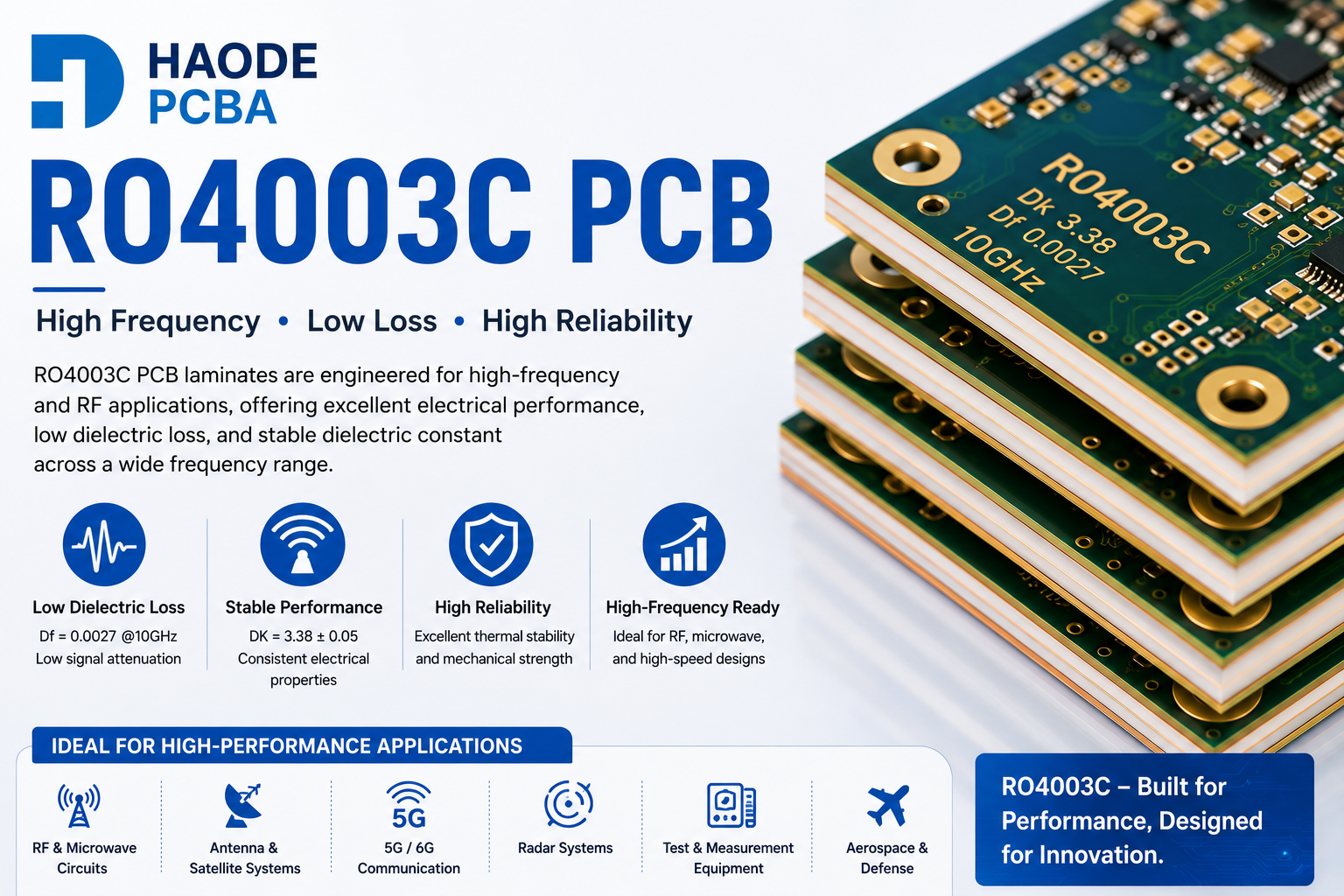
RO4003C PCB is a high-performance circuit board solution designed for RF, microwave, and high-frequency electronic applications. Developed by Rogers Corporation, RO4003C combines excellent electrical performance with cost-effective manufacturing compatibility, making it one of the most widely used laminate materials for modern communication and wireless systems.
Unlike traditional FR-4 materials, RO4003C PCB provides a more stable dielectric constant, lower signal loss, and improved impedance control at high frequencies. These advantages make it suitable for applications including 5G communication equipment, GPS systems, automotive radar, satellite electronics, and industrial RF devices.
For engineers and purchasing teams, selecting the correct high-frequency PCB material is essential because laminate performance directly affects signal integrity, product reliability, and overall manufacturing cost.
What Is RO4003C PCB?
RO4003C PCB is a high-frequency printed circuit board manufactured using Rogers RO4003C laminate material. It is a ceramic-filled hydrocarbon thermoset material reinforced with woven glass, providing electrical characteristics similar to PTFE-based materials while maintaining easier PCB fabrication.
RO4003C was developed to solve a common challenge in RF PCB manufacturing:
How can engineers achieve high-frequency performance without the complex processing requirements of traditional microwave materials?
The answer is a laminate that provides:
- Low dielectric loss
- Stable dielectric constant
- Excellent dimensional stability
- Standard PCB processing compatibility
- Reliable high-volume manufacturing capability
RO4003C PCB Key Material Properties
The electrical characteristics of RO4003C make it suitable for demanding RF applications.
Stable Dielectric Constant
A stable dielectric constant is critical for accurate RF circuit design.
RO4003C provides predictable electrical performance, allowing engineers to design:
- Controlled impedance transmission lines
- RF filters
- Antenna circuits
- Microwave components
Stable Dk performance reduces signal variation and improves product consistency.
Low Dissipation Factor
The dissipation factor determines how much energy is lost as heat when signals travel through the PCB material.
RO4003C offers low dielectric loss, which helps:
- Reduce insertion loss
- Improve transmission efficiency
- Maintain signal quality
This makes it suitable for high-frequency communication systems.
Excellent Dimensional Stability
High-frequency PCB designs require precise manufacturing control.
RO4003C provides:
- Low thermal expansion
- Reliable layer registration
- Better mechanical stability
These characteristics improve manufacturing yield and long-term reliability.
RO4003C PCB Vs FR4 PCB
| Feature | RO4003C PCB | FR4 PCB |
|---|---|---|
| Frequency Performance | Excellent | Moderate |
| Dielectric Stability | High | Variable |
| Signal Loss | Low | Higher |
| RF Applications | Excellent | Limited |
| Cost | Higher | Lower |
| Manufacturing | Standard PCB Process | Easy |
FR4 remains the preferred choice for general electronics, while RO4003C is selected when RF performance becomes a critical requirement.
RO4003C PCB Applications
5G Communication Systems
5G equipment requires stable high-frequency performance.
RO4003C PCBA is used in:
- RF modules
- Antenna systems
- Base station components
- Wireless communication equipment
Automotive Radar
Modern vehicles use radar systems operating at high frequencies.
RO4003C supports:
- Signal accuracy
- Stable transmission
- Reliable operation under temperature changes
Applications include:
- Adaptive cruise control
- Collision detection
- Autonomous driving sensors
GPS And Satellite Communication
Satellite and navigation systems require extremely reliable RF performance.
RO4003C PCBA helps maintain:
- Signal stability
- Low transmission loss
- Long-term reliability
Industrial Wireless Equipment
Industrial applications require durable communication solutions.
Examples include:
- Wireless sensors
- Industrial controllers
- IoT gateways
- Automation systems
RO4003C PCB Manufacturing Process
Manufacturing RO4003C PCB requires careful process control.
Important steps include:
- Engineering Review
- Material Preparation
- Inner Layer Processing
- Lamination
- Drilling
- Copper Plating
- Circuit Pattern Formation
- Surface Finishing
- Electrical Testing
- Quality Inspection
Although RO4003C is easier to process than PTFE materials, manufacturers still need experience with high-frequency PCBA production requirements.
How To Reduce RO4003C PCB Cost
Although RO4003C provides excellent performance, proper design optimization can reduce total cost.
Optimize Layer Count
A carefully designed stackup can achieve required performance with fewer layers.
Select Appropriate Copper Thickness
Not every application requires heavy copper.
Complete DFM Review
Early engineering review helps identify:
- Manufacturing risks
- Unnecessary complexity
- Cost-saving opportunities
Choose An Experienced Manufacturer
A qualified RO4003C PCBA manufacturer can improve:
- Production yield
- Material utilization
- Delivery time
- Overall project cost
Why Choose Haode PCBA For RO4003C PCB?
Haode PCBA provides professional RO4003C PCB Manufacturing and PCBA assembly services for global customers.
Our capabilities include:
- High-frequency PCB fabrication
- Rogers material sourcing
- Controlled impedance manufacturing
- RF PCB engineering support
- SMT assembly
- Prototype and mass production
- Quality inspection
- Global delivery support
With experience in advanced PCB technologies, Haode PCBA helps customers transform RF designs into reliable production-ready products.
Conclusion
RO4003C PCB provides an excellent balance between high-frequency performance, manufacturing reliability, and cost efficiency. Compared with traditional FR4 materials, it offers better dielectric stability, lower signal loss, and improved RF performance.
For applications such as 5G communication, automotive radar, satellite systems, and industrial wireless equipment, RO4003C remains one of the most practical high-frequency PCB material choices.