
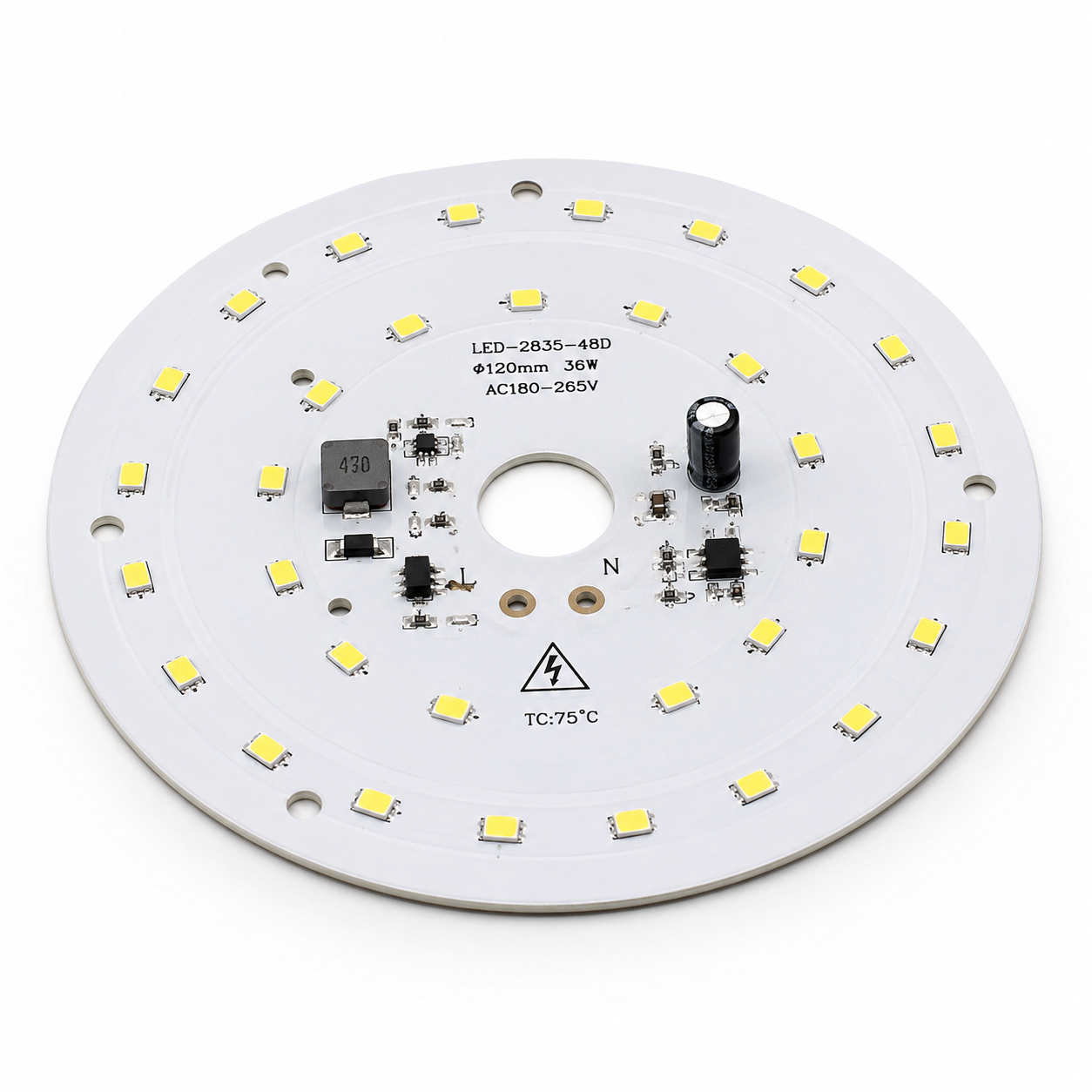
LED PCB Board Must Control Heat, Current, Solder Quality, And Material Stability To Keep LED Brightness, Color, Efficiency, And Service Life Reliable.
What Is A LED PCB Board?
A LED PCB Board Is A Printed Circuit Board Used To Mount, Connect, And Support Light-Emitting Diodes.
It provides electrical connection, mechanical support, and heat transfer. It is widely used in LED bulbs, strips, street lights, backlights, automotive lighting, signage, grow lights, and industrial lamps.
Why LED PCB Board Is Different From Standard PCB
A LED PCB Board Handles More Heat Than Many Standard Circuit Boards.
LEDs create light, but they also generate heat. If the PCB cannot move that heat away, brightness drops, color shifts, solder joints weaken, and the lighting product fails earlier.
How Does A LED PCB Board Work?
A LED PCB Board Sends Current To LED Components And Moves Heat Away From The LED Junction.
Heat usually moves from the LED package to the solder pad, copper layer, dielectric layer, base material, heat sink, and surrounding air.
Main Types Of LED PCB Board
Common types include FR4 LED PCB, Aluminum LED PCB, Copper Core LED PCB, Ceramic LED PCB, Flexible LED PCB, And Metal Core PCB For LED Lighting.
Each type fits a different power level, heat load, structure, cost target, and lighting environment.
FR4 LED PCB Board
A FR4 LED PCB Board Uses Fiberglass Epoxy Laminate.
It is suitable for low-power LED indicators, decorative lighting, simple control boards, small LED modules, and low-brightness backlights. It is cost-effective and easy to manufacture.
Aluminum LED PCB Board
An Aluminum LED PCBs Board Uses An Aluminum Base To Improve Heat Dissipation.
It is common in LED bulbs, downlights, panel lights, street lights, automotive lighting, and high-power LED modules. Aluminum helps transfer heat from LEDs to the lamp body.
Copper Core LED PCB Board
A Copper Core LEDs PCBA Board Offers Stronger Heat Spreading Than Many Aluminum PCBA Options.
It fits compact high-power LED modules, dense lighting engines, laser modules, and products with high current density. It costs more, but it supports better thermal performance.
Ceramic LED PCBs Board
A Ceramic LED PCBs Board Works Well In High-Power, High-Temperature, And High-Reliability LED Applications.
It is often used for UV LED, IR LED, COB LED, medical lighting, optical systems, and premium lighting modules. Ceramic can support stronger thermal performance than common FR4 boards.
Flexible LED PCBs Board
A Flexible LED PCBs Board Uses Polyimide Or Other Flexible Materials.
It is common in LED strips, curved lighting, signage, vehicle interiors, wearable lighting, and decorative lighting. It supports bending, but heat must still be managed carefully.
Metal Core PCB For LED Lighting
A Metal Core PCB, Also Called MCPCB, Uses A Metal Base Layer To Improve Heat Flow.
Most LED MCPCB products use aluminum or copper. A typical structure includes a copper circuit layer, thermal dielectric layer, and metal base layer.
LED PCB Board Structure
A typical LED PCB Board includes copper traces, solder pads, dielectric material, base substrate, solder mask, surface finish, and silkscreen.
For metal core LED PCB boards, the dielectric layer is critical. It must provide electrical insulation and thermal transfer at the same time.
Why Thermal Management Matters
Thermal Management Is The Core Of LED PCBs Board Performance.
Poor heat control can reduce luminous efficiency, shorten LED life, damage solder joints, and cause color shift. A good LED PCB keeps junction temperature within a safer range.
LED PCB Thermal Path
The thermal path usually starts at the LED chip and moves through the package, solder joint, copper pad, dielectric layer, substrate, heat sink, and air.
Every layer adds thermal resistance. One weak layer can limit the full heat dissipation system.
FR4 Vs Aluminum LED PCBs Board
FR4 LED PCB is cheaper and suitable for low-power lighting.
Aluminum LED PCB provides better heat transfer and supports higher-power LED modules. It is usually better for bulbs, downlights, street lights, and long-running lighting products.
Aluminum Vs Copper Core LED PCBs Board
Aluminum PCB balances cost, weight, and heat dissipation.
Copper core PCB offers stronger thermal spreading and current handling. It is better for compact high-power modules, but it increases cost and manufacturing difficulty.
Aluminum Vs Ceramic LED PCBA Board
Aluminum LED PCB is common in commercial lighting.
Ceramic LED PCB is better for high-heat, high-power, and high-reliability applications. It is often selected when thermal stability and long service life matter more than cost.
How To Choose LED PCBs Board Material
Choose FR4 LED PCB For low-power LEDs and control circuits.
Aluminum LED PCBA For standard LED lighting. Choose Copper Core LED PCB For compact high-power modules. Choose Ceramic LED PCBs For UV, IR, COB, and demanding thermal designs.
LED PCB Board Thickness
Common LED PCBs board thickness includes 1.0mm, 1.2mm, 1.5mm, 1.6mm, 2.0mm, and 3.0mm.
Thicker metal bases can improve strength and heat spreading. However, total thermal performance still depends on dielectric quality, copper thickness, and heat sink contact.
Copper Thickness For LED PCBA Board
Common copper thickness includes 1oz, 2oz, 3oz, and heavier copper.
High-current LED circuits may need thicker copper to reduce voltage drop and heat. Thicker copper also improves current capacity, but it may increase production cost.
Surface Finish For LED PCBA Board
Common surface finishes include HASL, Lead-Free HASL, OSP, ENIG, Immersion Silver, And Immersion Tin.
ENIG offers good flatness and oxidation resistance. It works well for fine-pitch LEDs, high-reliability modules, and boards that need longer shelf life.
Solder Mask For LED PCBA Boards
Solder Mask Protects Copper And Helps Prevent Solder Bridges.
White solder mask is common in LED lighting because it reflects light. Green, black, blue, and matte colors are also used for different optical and design needs.
White Solder Mask For LED PCBA Boards
White solder mask improves light reflection and visual brightness.
It is widely used in LED strips, backlight panels, lamp boards, and lighting modules. The manufacturer must control whiteness, curing quality, and surface cleanliness.
LED PCBs Board Design Rules
A strong LED PCB design must control current flow, heat flow, spacing, pad size, polarity marks, mounting holes, and copper area.
The design should match the LED package, driver circuit, lamp housing, heat sink, and final working temperature.
LED PCB Layout Tips
Place LEDs with enough spacing to reduce local hot spots.
Use wide copper areas for high-current paths. Keep driver components away from strong heat zones. Add thermal vias when the board structure supports them.
Thermal Via Design For LED PCB
Thermal vias help move heat from the top copper layer to lower layers or heat-spreading areas.
They are common in FR4 LED PCB designs. Via size, plating quality, filling method, and placement density all affect thermal performance.
LED PCB Board Manufacturing Process
The process includes DFM review, material cutting, imaging, etching, drilling, plating, solder mask, silkscreen, surface finish, profiling, electrical testing, and final inspection.
For aluminum and copper core PCB boards, bonding quality and mechanical processing need strict control.
LED PCB Assembly Process
LED PCB assembly includes solder paste printing, LED placement, reflow soldering, AOI inspection, optical inspection, electrical testing, and lighting test.
For high-power LED modules, solder joint quality directly affects heat transfer and long-term reliability.
LED PCBs Board For Street Lights
Street light PCBs need strong heat dissipation, weather resistance, stable current paths, and long service life.
Aluminum LED PCB is common because it transfers heat into the lamp housing. Outdoor lighting also needs corrosion control and reliable surface finish.
LED PCBA Board For Automotive Lighting
Automotive LED PCB boards need vibration resistance, heat resistance, and stable brightness.
They are used in headlights, tail lights, turn signals, daytime running lights, and interior lights. Material choice must support heat, shock, moisture, and long runtime.
LED PCBs
Board For Grow Lights
Grow light PCBs often run at high power for long hours.
They need strong heat spreading, stable solder joints, and controlled current distribution. Aluminum or copper core boards are common for high-output horticulture lighting.
LED PCB Board For LED Strips
LED strip PCBs usually use flexible materials or thin FR4.
They need stable copper traces, strong adhesion, clean solder pads, and good bending performance. For high-density LED strips, heat and voltage drop must be checked carefully.
LED PCB Board For COB LED Modules
COB LED modules place many LED chips in a compact area.
This creates high heat density. Aluminum, copper core, or ceramic substrates may be required to reduce thermal resistance and keep light output stable.
LED PCB Board For Backlight Modules
Backlight LED PCB boards need uniform brightness, clean solder mask, stable current, and accurate LED spacing.
They are used in displays, panels, keyboards, signage, and optical modules. Good layout helps reduce dark spots and brightness imbalance.
LED PCB Board For UV LED
UV LED PCB boards need stronger thermal control than many visible-light boards.
UV LEDs often generate high heat in a small area. Ceramic PCB, copper core PCB, or high-performance aluminum PCB may be used for better reliability.
LED PCB Board For High-Power Lighting
High-power LED PCB boards must control current density and thermal resistance.
The board should use proper copper thickness, thermal dielectric, metal core, heat sink contact, and reliable solder joints. Poor design can cause fast lumen decay.
LED PCB Board Quality Tests
Important tests include electrical test, AOI, solderability test, dimensional inspection, surface finish inspection, thermal review, and assembly quality check.
Finished LED modules may also need brightness, color temperature, current, voltage, and flicker testing.
Common LED PCB Board Defects
Common defects include poor solder joints, solder mask discoloration, delamination, warpage, open circuits, short circuits, weak plating, poor thermal contact, and surface oxidation.
Many defects come from poor material choice, weak process control, or incorrect thermal design.
What Affects LED PCB Board Cost?
Cost depends on material, board size, thickness, copper weight, thermal conductivity, surface finish, solder mask color, tolerance, quantity, and testing requirements.
Ceramic and copper core PCBs usually cost more than standard aluminum or FR4 LED PCB boards.
What Affects LED PCB Board Lead Time?
Lead time depends on material availability, board complexity, metal core processing, surface finish, testing needs, and order quantity.
Simple FR4 or aluminum LED PCB prototypes can move faster. Ceramic, copper core, and custom-shape boards usually need more production time.
How To Choose A LED PCB Board Manufacturer
Choose A Manufacturer That Understands LED Thermal Design, MCPCB Fabrication, Solder Mask Control, Surface Finish Quality, And PCB Assembly.
A good manufacturer should review your Gerber files, LED package data, current load, housing structure, heat sink design, and final working environment.
LED PCB Board Buying Checklist
Check material, thermal conductivity, dielectric thickness, copper thickness, board thickness, surface finish, solder mask color, LED package, current rating, working temperature, and testing method.
Do not choose only by price. Poor heat control can increase failure cost after installation.
Quick Selection Table
| Application | Recommended LED PCB Board |
|---|---|
| Indicator Light | FR4 LED PCB |
| Decorative Light | FR4 Or Flexible LED PCB |
| LED Strip | Flexible LED PCB |
| LED Bulb | Aluminum LED PCB |
| Downlight | Aluminum MCPCB |
| Street Light | Aluminum LED PCB |
| Automotive Light | Aluminum Or Copper Core PCB |
| High-Power COB LED | Copper Core Or Ceramic PCB |
| UV LED Module | Ceramic LED PCB |
| Grow Light | Aluminum Or Copper Core PCB |
| Backlight Module | FR4 Or Aluminum LED PCB |
LED PCB Board FAQ
What Is A LED PCB Board?
A LED PCB Board is a printed circuit board designed to mount LEDs, connect electrical paths, and transfer heat away from LED components.
Which PCB Is Best For LED Lighting?
Aluminum LED PCB is the most common choice for LED lighting because it balances cost, heat dissipation, strength, and manufacturing availability.
Can FR4 Be Used For LED PCB Board?
Yes. FR4 can be used for low-power LED boards, indicator lights, simple modules, and control circuits. High-power lighting usually needs better thermal materials.
Why Is Aluminum PCB Used For LED Lights?
Aluminum PCB helps transfer heat away from LED components. This improves brightness stability, reduces thermal stress, and supports longer lighting product life.
Is Copper Core LED PCB Better Than Aluminum PCB?
Copper core PCB can provide better heat spreading, but it costs more. It is better for compact, high-power, and high-current LED modules.
Is Ceramic PCB Good For LED Applications?
Yes. Ceramic PCB is good for UV LED, IR LED, COB LED, medical lighting, and high-reliability LED modules that require strong thermal stability.
What Causes LED PCB Failure?
Common causes include overheating, poor solder joints, weak thermal design, low-quality materials, bad surface finish, moisture, corrosion, and current overload.
What Files Are Needed For LED PCB Manufacturing?
A manufacturer usually needs Gerber files, drill files, BOM, pick-and-place file, assembly drawing, LED package data, and special thermal requirements.