Rogers PCB Vs FR4 PCB: Which PCB Material Is Better?
Introduction
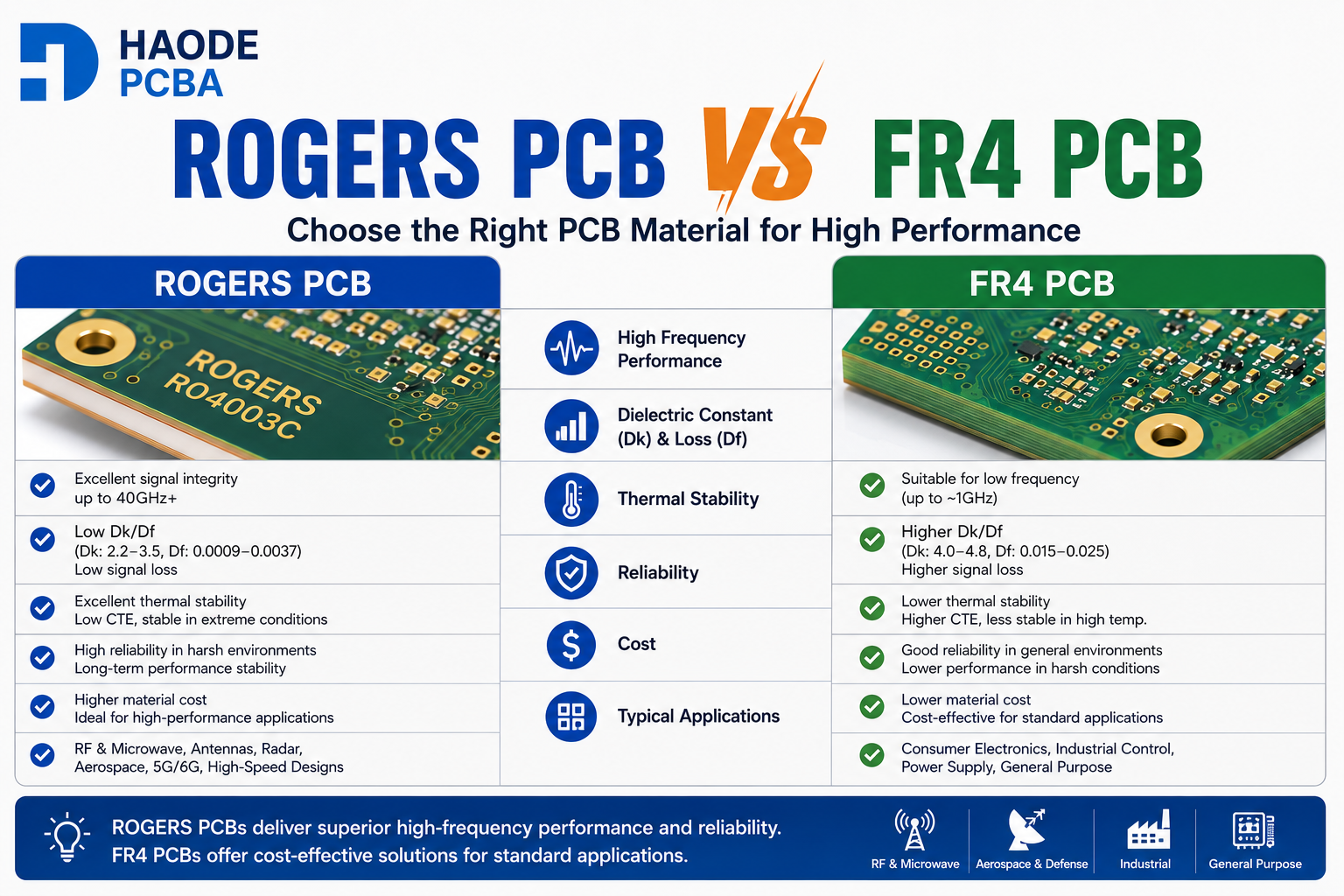
Choosing between Rogers PCB Vs FR4 PCB is one of the most important decisions when developing electronic products. While FR4 remains the most widely used PCB material because of its affordability and excellent mechanical strength, Rogers PCB materials provide superior electrical performance for high-frequency and RF applications.
The correct choice depends on your operating frequency, signal integrity requirements, environmental conditions, and project budget.
For general electronics, FR4 is usually the most practical solution. However, for applications such as 5G communication, radar systems, satellite equipment, and microwave circuits, Rogers PCB materials often provide the performance advantages required for reliable operation.
Quick Answer
Rogers PCB is better than FR4 PCBA for high-frequency, RF, microwave, and low-loss applications because it provides lower dielectric loss, more stable electrical performance, and better impedance control. FR4 PCB is better for cost-sensitive general electronics where extreme high-frequency performance is not required.
What Is FR4 PCB?
FR4 is the most common PCB substrate used worldwide.
It is made from:
- Fiberglass reinforcement
- Epoxy resin
- Copper foil
FR4 provides:
- Good mechanical strength
- Excellent manufacturability
- Low cost
- Reliable performance for general applications
Common FR4 PCB applications include:
- Consumer electronics
- Industrial controllers
- Power supplies
- Household devices
- Embedded systems
For most low and medium-speed circuits, FR4 offers an excellent balance between performance and cost.
What Is Rogers PCB?
Rogers PCB uses specialized high-performance laminate materials developed by Rogers Corporation.
Unlike traditional FR4, Rogers materials are designed specifically for applications requiring:
- High-frequency stability
- Low signal loss
- Accurate impedance control
- Excellent thermal reliability
Popular Rogers materials include:
- RO4350B
- RO4003C
- RT5880
- RO3003
- RO3010
These materials are widely used in:
- RF circuits
- Microwave systems
- Automotive radar
- Aerospace electronics
- 5G communication equipment
Rogers PCB Vs FR4 PCB: Key Differences
| Feature | Rogers PCB | FR4 PCB |
|---|---|---|
| Main Purpose | RF And High Frequency Applications | General Electronics |
| Dielectric Stability | Excellent | Moderate |
| Signal Loss | Very Low | Higher |
| Frequency Performance | Excellent | Limited |
| Cost | Higher | Lower |
| Manufacturing Difficulty | Higher | Easier |
| Thermal Stability | Excellent | Good |
| Impedance Control | Excellent | Moderate |
Dielectric Constant Comparison
The dielectric constant (Dk) directly affects signal propagation speed and impedance.
FR4 PCB
FR4 dielectric properties can vary depending on:
- Manufacturer
- Resin content
- Frequency range
- Glass weave structure
This variation may create challenges for high-frequency designs.
Rogers PCB
Rogers materials provide:
- More stable Dk values
- Better frequency consistency
- Improved design accuracy
This makes Rogers PCB a preferred choice for RF and microwave engineers.
Signal Loss Comparison
Signal loss becomes increasingly important as frequency increases.
FR4 PCB Limitations
At higher frequencies, FR4 may experience:
- Higher insertion loss
- Greater signal attenuation
- Reduced transmission efficiency
Rogers PCB Advantages
Rogers materials provide:
- Lower dielectric loss
- Better signal integrity
- Improved RF efficiency
Therefore, Rogers PCB is commonly selected for GHz-level applications.
Rogers PCB Vs FR4 PCB Cost Comparison
Cost is one of the biggest differences between these materials.
FR4 PCB Cost Advantages
FR4 offers:
- Lower material cost
- Easier processing
- Large supplier availability
- High manufacturing efficiency
This makes it ideal for:
- Large-volume consumer products
- Cost-sensitive applications
Rogers PCB Cost Factors
Rogers PCB costs more because of:
- Advanced laminate materials
- Specialized manufacturing requirements
- Additional engineering control
- More demanding inspection processes
However, the higher material cost is justified when performance requirements cannot be achieved with FR4.
When Should You Choose Rogers PCB?
Choose Rogers PCB when your design requires:
High Frequency Operation
Applications above several GHz often benefit from Rogers materials.
Examples:
- Radar
- Microwave communication
- 5G systems
Low Signal Loss
If signal attenuation affects system performance, low-loss materials are preferred.
Precise Impedance Control
RF circuits require predictable transmission line characteristics.
Harsh Operating Conditions
Rogers materials provide excellent:
- Thermal stability
- Environmental reliability
- Long-term performance
When Should You Choose FR4 PCB?
FR4 remains the best choice for many applications.
Choose FR4 when:
- Frequency requirements are moderate
- Cost is the main consideration
- Standard manufacturing is preferred
- Extreme RF performance is unnecessary
Applications include:
- Control boards
- Consumer electronics
- Industrial equipment
- Power electronics
Can Rogers PCB And FR4 Be Used Together?
Yes.
Many advanced products use hybrid PCB stackups combining Rogers and FR4 materials.
Benefits include:
- Reduced cost
- Improved RF performance
- Better mechanical strength
For example:
- RF signal layers may use Rogers material.
- Digital control layers may use FR4.
This approach provides a balance between performance and cost.
How To Choose The Right PCB Material
Before selecting Rogers PCB or FR4 PCB, consider:
Operating Frequency
Higher frequency usually requires better dielectric performance.
Signal Requirements
Evaluate:
- Insertion loss
- Impedance tolerance
- Signal integrity
Environmental Conditions
Consider:
- Temperature
- Humidity
- Mechanical stress
Budget Requirements
Select the material that meets technical requirements without unnecessary cost.
Why Choose Haode PCBA For Rogers And FR4 PCB Manufacturing?
Haode PCBA provides professional PCB manufacturing and PCB assembly services for both advanced RF applications and standard electronic products.
Our capabilities include:
- Rogers PCB fabrication
- FR4 PCB manufacturing
- High-frequency PCB solutions
- Controlled impedance production
- SMT assembly
- Component sourcing
- Prototype and mass production
- Quality inspection
With engineering support and manufacturing experience, Haode PCBA helps customers select the right PCB material based on performance, reliability, and cost requirements.
Conclusion
The choice between Rogers PCB Vs FR4 PCB depends on application requirements.
FR4 remains the best option for cost-effective general electronics, while Rogers PCB provides superior performance for high-frequency, RF, microwave, and advanced communication systems.
Selecting the correct material early in the design process helps improve reliability, reduce development risks, and achieve better product performance.