Printed circuit boards (also called circuit boards, printed wiring boards / PWB, or PCB boards) are the foundation that supports and electrically connects components in most electronics. A PCB is not just “a board with copper”—it is a layered structure of substrate + copper + protective coatings + markings, designed to deliver reliable connectivity, insulation, and manufacturability. main types of PCBs
This guide breaks down the main types of PCBs using the categories buyers and engineers actually use: layer count, board construction, and assembly method, plus a quick way to match each PCB type to real applications.
PCB Types by Layer Count (The Most Common Classification)
Single-Sided PCB (Single-Layer PCB)
A single-sided PCB (aka single-layer circuit board) uses one conductive copper layer on only one side of the substrate. It’s typically chosen when the circuit is simple, routing density is low, and cost needs to stay minimal. main types of PCBs
Best for
- Simple consumer electronics
- Power adapters (basic)
- Hobby or low-density control boards
Pros
- Lowest cost
- Easy to manufacture
Trade-offs
- Limited routing space
- Harder to support high component density
Double-Sided PCB (Double-Layer PCB)
A double-sided PCB (aka two-layer PCB) has copper on both sides of the core substrate. It supports more routing and more components than single-layer boards, while still staying relatively cost-efficient. main types of PCBs
Best for
- Industrial control boards (moderate complexity)
- Instrumentation
- Consumer products needing more routing
Pros
- Better routing flexibility
- Good balance of cost vs. complexity
Trade-offs
- More process steps than single-sided
- Via design becomes important for reliability
Multilayer PCB (4-Layer / 6-Layer / 8+ Layer Boards)
A multilayer PCB stacks multiple copper layers into one board using inter-layer connections (vias). This supports much higher circuit density, better signal routing, and improved power/ground management—making it common in complex, performance-driven electronics. main types of PCBs
Best for
- Communication equipment
- Computing devices
- High-speed digital, dense products
- Power-hungry or feature-rich electronics
Pros
- Highest routing density
- Better EMC/EMI control with dedicated planes
- Enables compact designs
Trade-offs
- Higher cost
- More stringent DFM/DFT requirements
PCB Types by Board Construction and Base Material
Rigid PCB (FR-4 PCB)
A rigid PCB is the standard “hard board” most people imagine. The most common substrate is FR-4 (flame retardant, grade 4) glass-reinforced epoxy laminate, chosen for its strength, insulation properties, and broad availability. main types of PCBs
Common use
- Most consumer electronics
- Industrial equipment
- General-purpose embedded products
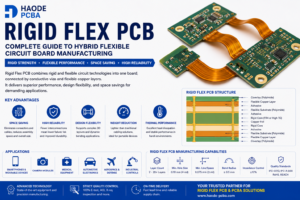
Flexible PCB (Flex Circuit / FPC)
A flex PCB (also called flex circuit or FPC) uses flexible base materials so the circuit can bend or fold. This helps when space is tight, products require movement, or cables/connectors should be reduced. main types of PCBs
Common use
- Wearables
- Cameras and mobile devices
- Hinged or compact assemblies
Key benefit
- Fits 3D shapes and moving structures better than rigid boards
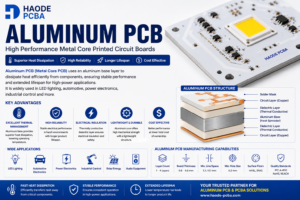
Metal Core PCB (MCPCB / Aluminum PCB)
A metal core PCB (often aluminum-based, also called MCPCB) improves heat spreading and thermal dissipation by using a metal core. It’s commonly selected when thermal performance is the bottleneck. main types of PCBs
Common use
- LED lighting
- Power conversion modules
- High-heat density applications
Key benefit
- Better thermal management to protect temperature-sensitive components
Low-Cost Phenolic PCBs (FR-2 / Perfboard-Style Substrates)
Some cheaper boards use phenolic resin materials (e.g., FR-2), sometimes associated with perfboard-style low-cost substrates. They can be adequate for basic products but are generally less robust than FR-4. main types of PCBs
Best for
- Very cost-sensitive, low-demand electronics
PCB Composition (What All PCB Types Share)
Even though PCB categories differ, most printed circuit boards share the same core “stack”:
Substrate (Core Material)
The substrate provides mechanical strength and electrical insulation. FR-4 is the most common rigid substrate. main types of PCBs
PCBs Copper Layer (Copper Foil / Copper Cladding)
Copper forms the conductive traces and pads. Copper thickness is often specified by “oz/ft²” (e.g., 1 oz copper). main types of PCBs
Solder Mask (Protective Coating)
Solder mask insulates copper traces and helps prevent solder bridging. Green is common, but other colors are possible. main types of PCBs
Silkscreen (Legend / Marking Layer)
Silkscreen adds reference designators, symbols, and assembly markings for human readability and easier build/repair. main types of PCBs
PCB Types by Assembly Method (How Components Are Mounted)
Through-Hole PCB Assembly (THT)
Through-hole assembly inserts component leads through drilled holes and solders on the opposite side, often preferred for larger parts or stronger mechanical connections. main types of PCBs
Typical components
- Larger capacitors
- Connectors
- High-stress mechanical parts
Surface Mount PCB Assembly (SMT)
Surface-mount technology (SMT) mounts components directly onto pads without lead-through holes, enabling higher density and smaller designs. main types of PCBs
Typical components
- Resistors, diodes, small ICs
- High-density consumer electronics parts
Mixed Technology (SMT + THT)
In many real-world products, manufacturers commonly use a hybrid approach. Specifically, they apply SMT for the majority of small and lightweight components because it enables high-speed, automated placement. Meanwhile, through-hole technology is still widely used for connectors and heavier parts, since it provides stronger mechanical bonding and improved durability. As a result, understanding the main types of PCBs and their compatible assembly methods becomes essential for achieving optimal product performance and reliability.
Common PCB Component Types (What PCBs Carry)
A PCB’s job is to connect and support components—common parts include batteries, resistors, capacitors, diodes, LEDs, inductors, switches, and transistors. These form the functional building blocks of the circuit. main types of PCBs
How to Choose the Right PCB Type (Fast Decision Logic)
Choosing the right PCB type is a critical step in electronic product development. Different types of PCBs—including single-sided boards, double-sided boards, multilayer PCBs, flex circuits, and metal core PCBs—are designed to meet specific requirements for circuit complexity, mechanical performance, thermal management, and manufacturing efficiency.
To quickly and accurately select the most suitable printed circuit board type, engineers and buyers should first evaluate several critical decision factors. By systematically reviewing these key considerations, they can reduce selection errors, improve design compatibility, and ultimately ensure optimal product performance and manufacturing efficiency.
1.Choose by Complexity
- Low complexity → single-sided PCB
- Medium complexity → double-sided PCB
- High complexity / high-speed / high density → multilayer PCB
2.Choose by Mechanical Form
- Needs bending or folding → flex PCB
- Needs rigidity and general durability → rigid FR-4 PCB
3.Choose by Heat Load
- Heat concentrated (LEDs, power devices) → metal core PCB (MCPCB)
4.Choose by Assembly and Reliability
- Mechanical strength & easy serviceability → through-hole (THT)
- Compact density & volume production → SMT
Haode Inc. for All Your PCB Manufacturing Needs
At Haode Inc., we know that success in the electronics manufacturing industry depends on attention to detail at every level, from the beginning stages of planning to the shipment of the last part. That’s why we make it a priority to deliver to you exactly what it is you need to get the job done.
We offer contract manufacturing services, electronic assembly, PCB assembly — including through-hole and surface mount technologies — as well as full testing and inspection services to ensure the products we send you conform not just to our standards, but to yours, too. To get a full list of our services, or to learn more about what we offer and how we can help, feel free to reach out to us via our website or give our offices a call at +86 157 6785 7371