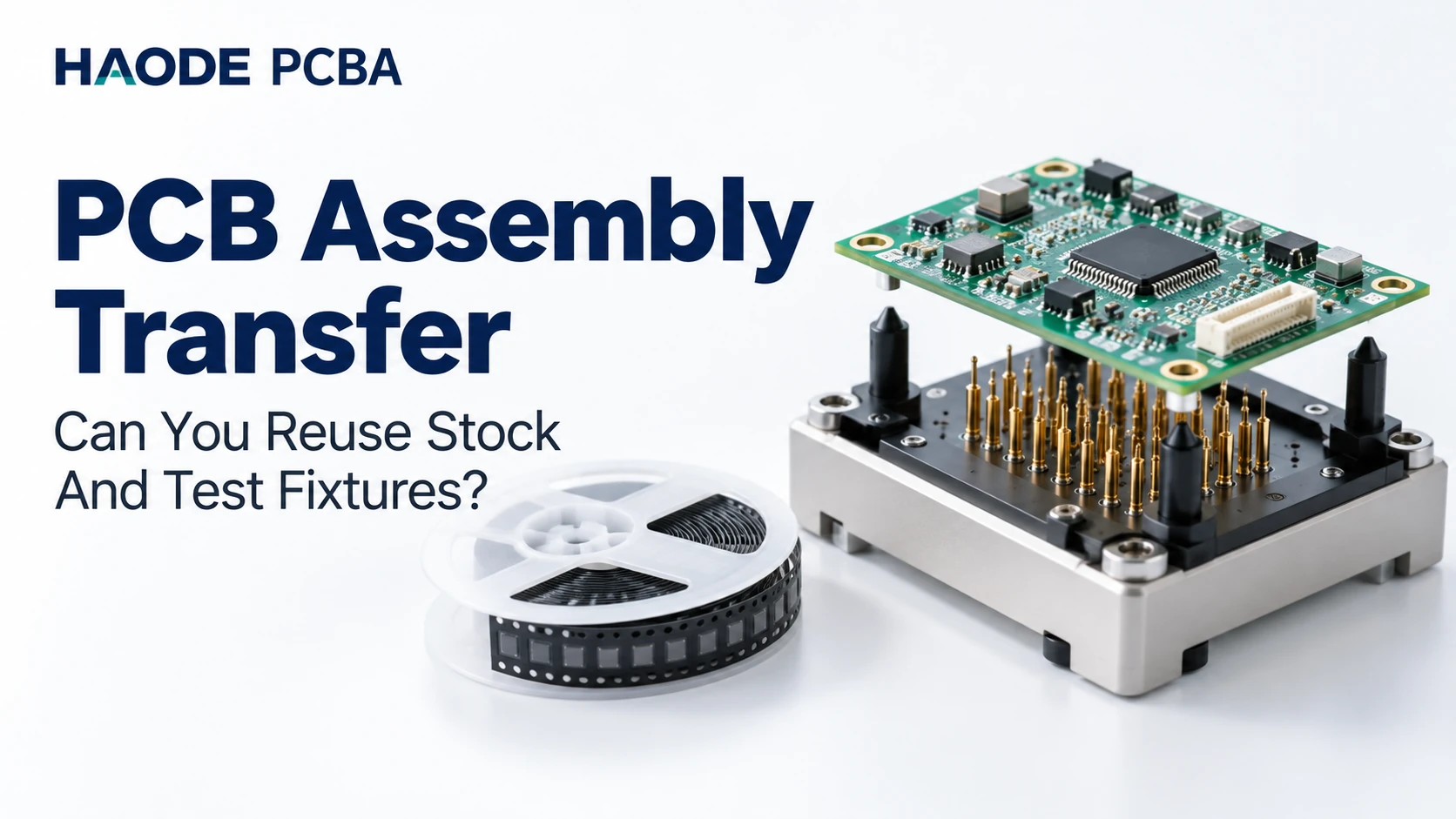
PCB assembly transfer can reuse existing components and test fixtures when their identity, condition and suitability are verified. Before scheduling production at a new supplier, separate what can move immediately from what needs investigation, adaptation or replacement.
The difficult question is often practical: “My current assembler holds our remaining chips and the test jig. Can the next factory use them, or will we pay for everything again?”
Start with three acceptance gates: usable material, a working test setup and an approved pilot build. A shipment of reels and fixtures does not establish any of those by itself.
What Must A PCB Assembly Transfer Inventory Show?
Ask the outgoing supplier for a physical inventory tied to the approved PCB BOM. An account balance saying “2,000 MCUs available” is insufficient if the part suffix, lot identity or quantity reserved for unfinished boards is unclear.
Use the following handover table as a proposed starting point.
| Item | Evidence To Request | Decision Before Use |
|---|---|---|
| Unopened reels or trays | Full manufacturer part number, quantity, lot labels and packaging condition | Confirm identity and receiving acceptance |
| Opened moisture-sensitive components | Bag labels, opening history and available dry-storage records | Review handling requirements before release |
| Partially used reels | Count, remaining labels and carrier condition | Confirm usable quantity and feeder compatibility |
| Programmed ICs | Firmware identity, configuration and serialization status | Confirm suitability for the intended release |
| Unfinished assemblies | Board revision, completed operations, defects and rework history | Define which units the new supplier can accept |
| Test fixtures and programmers | Asset list, drawings, software, accessories and operating instructions | Establish whether the complete setup can run |
Record dispatched and received quantities separately. If the receiving count differs, resolve the discrepancy before treating the stock as available for production.
Also list pending component orders separately from stock already on the shelf. Otherwise, both factories may purchase material against the same demand.
Can Leftover Components Be Used At The New Factory?
Sometimes, but decide by part and lot rather than approving the entire shipment together.
Texas Instruments’ product shelf-life guidance explains that storage life depends on packaging, moisture sensitivity, storage conditions and other factors. A date code alone does not establish whether a transferred component is suitable for assembly.
For opened moisture-sensitive parts, missing exposure history creates an unresolved handling question. Ask the receiving team to review the device requirements and available records. Do not assume that resealing a bag restores its allowable floor life, or apply one baking recipe to every package and carrier.
Your moisture sensitivity level review should identify which stock can enter the line and which needs further disposition.
Calculate Buildable Kits, Not Total Parts
Consider an illustrative transfer for 500 boards:
- Each board requires one MCU and two identical memory ICs.
- Receiving accepts 540 MCUs and 920 memory ICs.
- The memory stock supports only 460 complete boards, before setup or process allowances.
The shipment contains more than 1,000 components, yet it cannot support the planned order. Calculate the kit limit for every BOM line, then agree any additional quantity needed for setup, attrition and replacement.
For preprogrammed parts, also check whether device-specific identifiers have already been allocated. Moving the chips must not cause the new station to reuse serial numbers assigned elsewhere.
Which Test Fixtures Can Survive A PCB Assembly Transfer?
A fixture is reusable only if the receiving factory can operate and verify the complete test setup.
A jig with the correct connector may still depend on missing software, a particular instrument, an unavailable license or an undocumented configuration. Therefore, request the fixture package before committing to reuse.
That package should identify:
- Fixture revision, wiring and connector pinout.
- Test application, required runtime, drivers and authorized licenses.
- Instrument models, settings and relevant calibration records.
- Programming files, target-device settings and configuration.
- Test limits, sequence, result format and operator instructions.
- Reference boards with recorded expected results.
For example, the SEGGER J-Flash manual documents project settings, programming verification and production-related options. If a transferred station uses J-Flash, sending only the firmware binary leaves other setup information to be reconstructed. Other tools require their own corresponding configuration package.
Check More Than A Passing Reference Board
A known-good board helps confirm normal operation, but it does not show that the station detects the defects it is intended to catch.
Where safe and appropriate, use an approved failed reference or a controlled simulated fault to check a specific rejection condition. Define the expected result beforehand. This is a proposed verification method, not a claim that one failed reference proves complete test coverage.
Document the checks in the PCBA functional testing specification. If the transferred station produces different measurements, investigate fixture contacts, settings, calibration and product variation before changing acceptance limits.
What If The Old Supplier Cannot Provide The Complete Setup?
Create a gap list before asking the new factory for a firm production date.
| Missing Item | Practical Next Step |
|---|---|
| Usable test software | Estimate redevelopment against an approved test specification |
| Fixture wiring information | Assess whether the fixture can be documented or needs rebuilding |
| Approved programming configuration | Re-establish it with the product engineering owner |
| Reliable inventory records | Reconcile and inspect stock before counting it as usable |
| Measurable acceptance criteria | Agree requirements before the pilot build |
For commercial clarity, ask both parties to confirm which assets can be supplied and which software permissions are available. Include any agreed transfer charges and unresolved items in the handover record.
A lower assembly unit price may be outweighed by fixture redevelopment, replacement parts or duplicated purchases. Ask the quote to separate these one-time costs from recurring assembly charges.
How Should The First Transfer Build Be Approved?
Treat the first PCB assembly transfer lot as a controlled pilot with written release conditions.
Choose its quantity according to product risk, available material and the questions it must answer. There is no universal pilot quantity that suits every assembly.
Before building, agree:
| Gate | Evidence Needed |
|---|---|
| Material release | Accepted parts and quantities, with unresolved stock held separately |
| Configuration release | Approved board, BOM, firmware and test revisions |
| Setup verification | Recorded fixture and programming checks |
| Product acceptance | Inspection and functional results against agreed requirements |
| Production release | Named approval and disposition of open issues |
Use first article inspection to confirm the agreed assembly requirements, alongside the electrical and functional checks needed for the product.
Keep the previous production source available where practical until the replacement source has met the release conditions. Base any buffer-stock decision on demand, usable finished stock and the actual transfer schedule.
What Records Should Close A PCB Assembly Transfer?
At the end of the pilot, request a reconciliation of received material, consumed parts, approved losses, rejected stock and remaining inventory. This makes the next order easier to plan and highlights discrepancies while the handover is still recent.
Also retain the approved configuration, test records, fixture changes and unresolved exceptions. Define the required PCBA traceability level explicitly; do not assume every component lot is automatically linked to every board serial number.
A transfer is ready for routine production when the incoming supplier can demonstrate the agreed build and test process, and the buyer has approved the remaining exceptions.
For a transfer enquiry to Haode PCBA, prepare the BOM, material balance, fixture description, test requirements and target quantity. Use the PCB assembly quote checklist to organize the request, and ask for separate estimates for reuse assessment, any required redevelopment and recurring production.