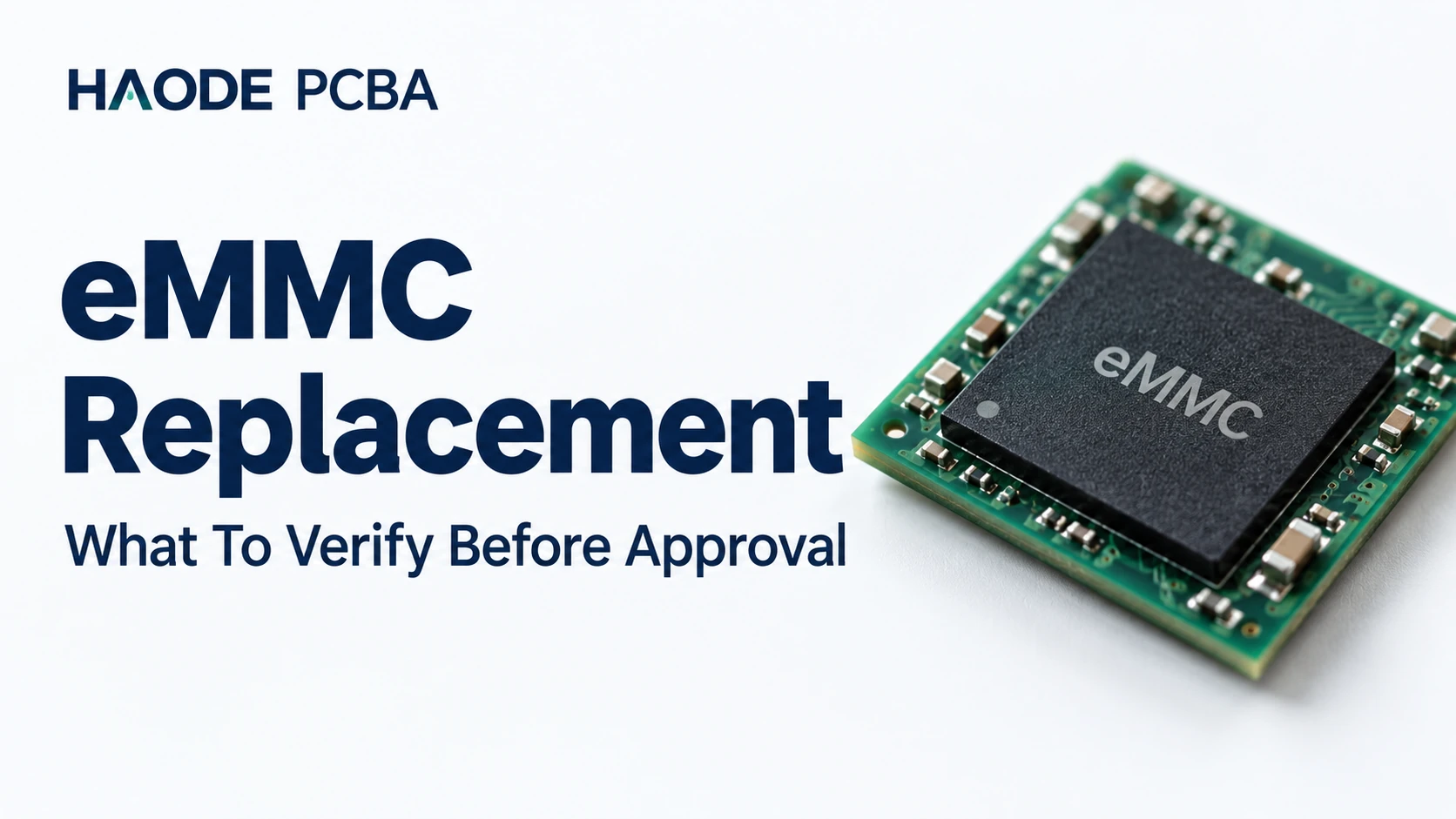
eMMC replacement should receive production approval only after the proposed device passes a documented review of its package, electrical interface, boot configuration, programming process, and product-level behavior. Matching capacity and ball count identifies a candidate; it does not establish that an existing PCBA will boot or operate correctly.
This distinction matters when the original memory becomes unavailable and purchasing needs a substitute quickly. The decision is whether the approved hardware, software, and manufacturing process can use the new device consistently.
emmc-replacement.webp
Illustrative approval framework. Final requirements depend on the exact memory device, processor, and product.
Why Can An eMMC Replacement Be Detected But Fail To Boot?
A working connection to a memory device does not exercise the complete boot path. Software already running on a processor may identify or access storage under conditions different from those used by its boot ROM.
A public NXP support discussion illustrates the distinction. The author reported that boards fitted with a proposed replacement remained in download mode although U-Boot detected the new eMMC. This report establishes the observed symptoms; it does not prove a universal cause.
The engineering review should therefore distinguish four results:
- The host detects the device.
- The programming tool writes and verifies the intended image.
- The processor boots from the intended storage location.
- The application meets its operating requirements.
Each result answers a different question. A purchasing approval should identify which of these checks the team has actually completed.
When shortage drives the change, link the review to the product’s component obsolescence plan. That keeps a temporary purchasing decision from becoming an undocumented permanent design change.
What Must Purchasing Collect Before Ordering Trial Parts?
Request the complete original and proposed manufacturer part numbers, current datasheets, package drawings, supplier identity, traceability information, and any manufacturer migration guidance. Include the existing board revision and software release in the request.
A sales description such as “same size, same capacity” leaves too many conditions undefined. Likewise, a manufacturer’s general family brochure cannot establish the specifications of an exact ordering code.
Kingston’s eMMC overview describes managed NAND with an integrated controller and standardized host interface. This explains the product category; it does not certify interchangeability between two particular devices.
Use the following review matrix before an unrestricted production purchase. Assign each row to an owner and retain the supporting document or test record.
| Review Area | Question To Resolve | Evidence Needed |
|---|---|---|
| Physical fit | Do dimensions, ball assignments, pitch, and height suit this board? | Drawing comparison against the released footprint |
| Electrical fit | Are supply, I/O, reset, and operating conditions compatible? | Exact datasheets and schematic review |
| Host support | Does the processor and software stack support the required operating modes? | Host documentation and version-specific evaluation |
| Boot setup | Are the boot region, image placement, and configuration appropriate? | Approved provisioning script and captured configuration |
| Storage layout | Does the image fit the actual available areas and partition layout? | Layout review and programming verification |
| Workload | Does the device meet the product’s write, latency, and temperature needs? | Application requirements and a representative test plan |
| Production fit | Can the factory source, handle, assemble, and program the part? | Manufacturing review and controlled trial results |
Keep sourcing evidence with the component procurement record. A technically suitable candidate still needs an acceptable purchasing route.
Which Boot And Programming Details Need Explicit Approval?
Boot Region And Image Placement
Record which storage area contains each image, its offset, and the tool used to program it. Do not assume that copying the main user area reproduces every setting or boot image on an existing device.
Processor-specific documentation is essential. For example, NXP’s i.MX35 boot application note discusses eMMC boot configuration and boot partition selection for that processor. Its commands and behavior must not be applied unchanged to a different processor family.
The production instruction should identify the approved image locations explicitly. Otherwise, an operator may complete a successful write to an area the processor does not use during startup.
Configuration And Protected State
Compare the configuration required by the product with the new device’s supported features and initial state. Record settings before and after provisioning rather than relying only on a successful tool message.
If the design uses authenticated storage, protected regions, or one-time settings, assign their provisioning to the responsible engineer. Some operations cannot be freely reversed. An ordinary storage image should not be assumed to reproduce protected state or credentials.
Firmware And Test Dependencies
Confirm whether the substitute changes initialization, timing, identification handling, or the production programming job. If a software change is necessary, approve a hardware–firmware combination rather than listing the new memory as an unconditional alternate.
Update the production BOM with that condition. Otherwise, the next repeat order may combine an approved chip with an incompatible older software release.
For example, “approved with firmware revision B or later” needs a clearly defined, validated scope. It should not automatically authorize future software versions that have never been assessed with the replacement.
How Should A Trial Build Be Structured?
Separate compatibility evaluation from assembly-process evaluation. Replacing a chip on an existing board can provide useful evidence, but it also introduces rework as another variable.
Therefore, preserve a working reference unit and its configuration. If the trial uses reworked boards, record their thermal and repair history under the BGA rework procedure. Where the decision warrants it, include freshly assembled trial boards before approving the normal production process.
| Trial Check | What To Record | Why A Simple Pass Is Insufficient |
|---|---|---|
| Image programming | Tool/job revision, written regions, verification method | A write result does not demonstrate boot |
| Cold power-on | Startup outcome and time under defined power conditions | A software reset may not reproduce power-on behavior |
| Reset and recovery | Each required reset or recovery path | One successful startup covers only one path |
| Application workload | Read/write behavior and required performance | Device identification exercises little of the workload |
| Update process | Update result and recovery behavior where required | Factory programming may bypass the field update path |
| Power interruption | Defined interruption points and data-integrity criteria | Uncontrolled unplugging produces ambiguous evidence |
Choose sample size, cycle counts, operating conditions, and acceptance limits from product risk and requirements before testing. There is no universal “ten boards passed” rule that proves compatibility or service life.
Also distinguish qualification from routine PCBA functional testing. A detailed engineering evaluation establishes suitability; production tests screen the manufactured units against the agreed coverage.
What If A Reworked Trial Board Fails?
Preserve the programming log, configuration, startup observations, and rework history before changing anything else.
Then identify the earliest stage that fails: communication, programming, boot, or application operation. Compare that stage with the working reference under controlled conditions.
A failure after chip replacement does not, by itself, establish whether the cause is the substitute, its configuration, the software, or the rework process. Changing several variables at once makes that distinction harder.
When Should You Approve, Restrict, Or Reject The Substitute?
Use three decisions with clear consequences.
| Decision | Meaning | Required Action |
|---|---|---|
| Approved for the specified build | Evidence meets the agreed requirements | Release the exact part, revisions, and production instructions |
| Approved with conditions | The part works only with a defined change or restricted application | Document the condition and prevent unsupported combinations |
| Hold or reject | Evidence is incomplete or a requirement fails | Stop unrestricted release and assign the unresolved issue |
The approval record should name the engineering approver, procurement owner, manufacturing owner, supported revisions, evidence location, and date. Reference it during first article inspection.
Before signing, confirm that the record answers these questions:
- Which exact replacement part number is approved?
- Which hardware and firmware combination did the team evaluate?
- What programming configuration must production use?
- Which tests passed, and under what conditions?
- Are any limitations or unresolved issues still open?
- Does approval cover the trial only or subsequent production orders?
Finally, associate the actual installed memory lot with the affected board population through PCBA traceability. This makes it possible to distinguish the trial, the original build, and the released replacement build later.
What Should You Send Haode For An eMMC Replacement Review?
Send both part numbers, the current BOM, schematic sections relevant to the memory, board revision, boot architecture, firmware release, and the reason for replacement. Include any existing failure logs and the required quantity and delivery window.
Ask Haode to confirm the sourcing, assembly, programming, and test scope it can support for that specific project. The product engineering team should retain responsibility for approving compatibility and application requirements.
Before releasing a production order, make sure the approved part, software combination, programming instructions, and acceptance evidence are all identifiable. That gives purchasing a clear basis for ordering and gives the factory a configuration it can reproduce.