What Is Rigid Flex PCB?
Definition Of Rigid Flex PCB
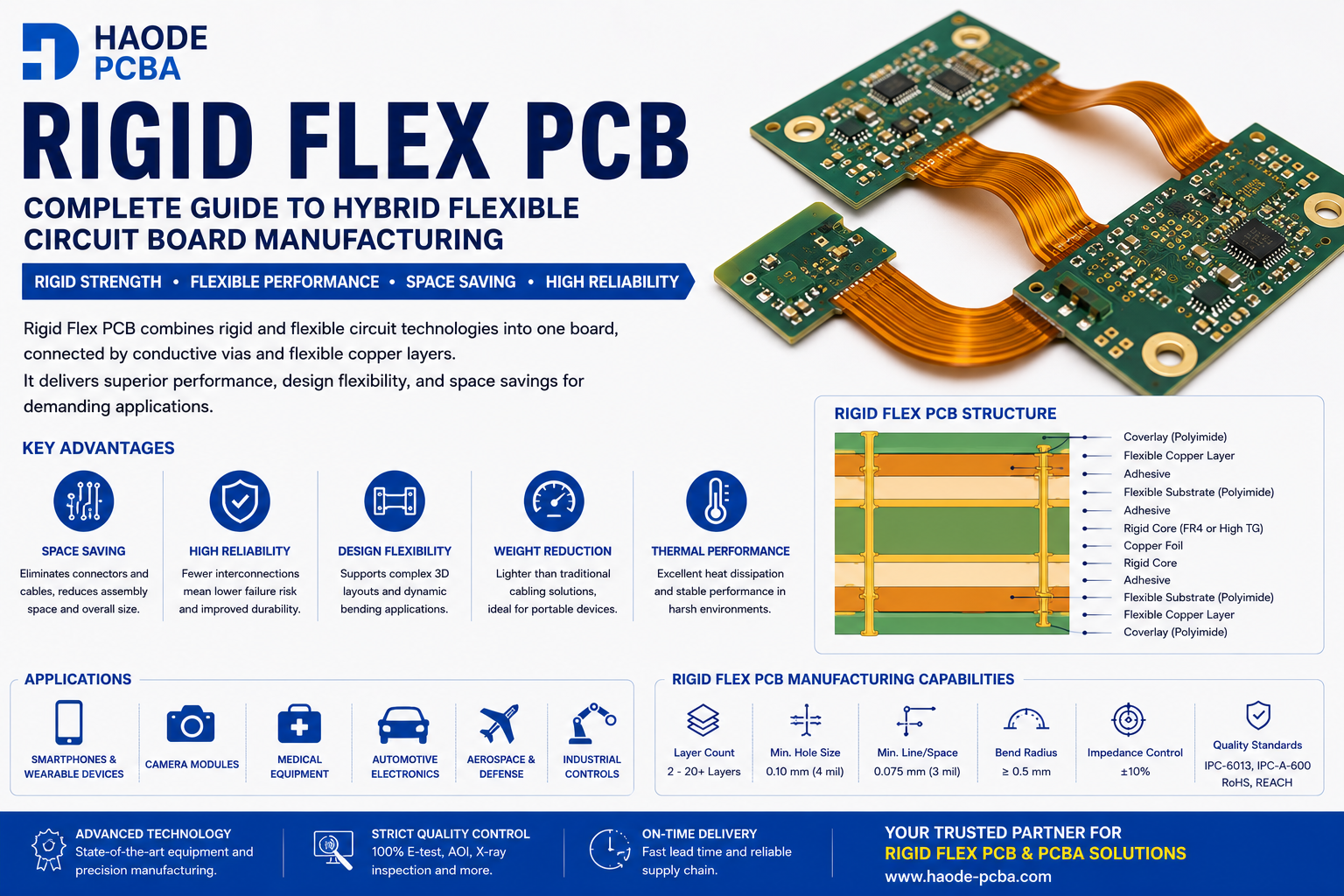
Rigid Flex PCB is an advanced printed circuit board technology that combines rigid PCBA sections and flexible circuit sections into one integrated circuit structure.
Unlike traditional electronic designs that require separate rigid boards connected by cables or connectors, rigid flex technology allows multiple circuit sections to work together as a single PCBA solution.
A typical Rigid Flex PCB consists of:
- Rigid PCB Layers
- Flexible Polyimide Layers
- Copper Conductive Layers
- Coverlay Materials
- Adhesive Bonding Layers
This hybrid structure provides both mechanical strength and bending capability, making it ideal for complex electronic products with limited installation space.
Why Rigid Flex PCB Is Important For Modern Electronics
Modern electronic products require:
- Smaller dimensions
- Lower weight
- Higher reliability
- Better signal performance
- Reduced assembly complexity
Traditional PCB solutions often need additional:
- Connectors
- Wire Harnesses
- Mechanical Supports
These extra components increase:
- Assembly time
- Failure points
- Product size
- Manufacturing complexity
A Rigid Flex PCB Manufacturer can integrate these functions into a single board structure, improving product reliability and simplifying assembly.
Rigid Flex PCB Structure And Materials
Rigid PCB Section Materials
The rigid part of a rigid flex circuit usually uses traditional PCBA materials.
Common materials include:
- FR4
- High Tg FR4
- Low Loss Materials
- High Frequency Laminates
For advanced applications requiring high-speed signal transmission, manufacturers may combine rigid sections with materials from suppliers such as Rogers Corporation.
Rogers provides specialized PCB laminates designed for RF, microwave, and high-frequency applications.
Flexible Circuit Section Materials
The flexible section typically uses polyimide-based materials.
Common flexible PCB materials include:
- Polyimide Film
- Rolled Annealed Copper
- Coverlay Film
Polyimide is widely used because it provides:
- Excellent temperature resistance
- High flexibility
- Good dimensional stability
- Long-term reliability
Copper Layer Selection
Copper selection directly affects electrical performance and mechanical durability.
Common copper types include:
Rolled Annealed Copper (RA Copper)
RA copper is commonly used for applications requiring repeated bending.
Advantages:
- Better flexibility
- Improved fatigue resistance
- Suitable for dynamic bending applications
Electro Deposited Copper (ED Copper)
ED copper provides good electrical performance and is commonly used in standard flexible circuit applications.
Material selection depends on:
- Bend requirements
- Current capacity
- Product reliability requirements
Types Of Rigid Flex PCB
Single Flex Layer Rigid Flex PCBA
This structure uses one flexible circuit layer combined with rigid sections.
Advantages:
- Lower manufacturing complexity
- Cost-effective solution
- Suitable for simple applications
Common applications:
- Sensors
- Industrial electronics
- Compact control systems
Multilayer Rigid Flex PCB
Multilayer rigid flex designs provide higher circuit density.
Advantages:
- More routing space
- Better electrical performance
- Reduced connector requirements
Applications:
- Medical equipment
- Aerospace electronics
- Advanced industrial systems
HDI Rigid Flex PCB
HDI rigid flex PCB combines:
- Microvia technology
- Fine-line routing
- Flexible circuits
This structure supports highly compact electronic products.
Applications:
- Wearable devices
- High-end medical equipment
- Advanced communication products
Rigid Flex PCB Manufacturing Standards
IPC Standards For Rigid Flex PCB
Reliable rigid flex PCBA production requires strict manufacturing control because flexible materials and rigid materials have different mechanical properties.
Professional manufacturers commonly follow industry standards developed by organizations such as IPC.
IPC provides widely recognized guidelines for PCB fabrication, assembly quality, and acceptance requirements.
Following recognized standards helps manufacturers maintain:
- Manufacturing consistency
- Product reliability
- Quality inspection requirements
Advantages Of Rigid Flex PCB
Reduced Product Size
Rigid flex technology eliminates many external connectors and cables.
Benefits include:
- Smaller product dimensions
- Better space utilization
- Simplified assembly
Improved Reliability
Traditional cable connections may create potential failure points.
Rigid flex PCBA reduces:
- Connector failures
- Wiring problems
- Assembly errors
Better Mechanical Performance
Rigid flex boards can withstand:
- Vibration
- Mechanical movement
- Limited bending
This makes them suitable for demanding environments.
Reduced Assembly Complexity
A single integrated PCB solution can replace multiple connected boards.
Benefits include:
- Lower assembly time
- Fewer components
- Easier product integration