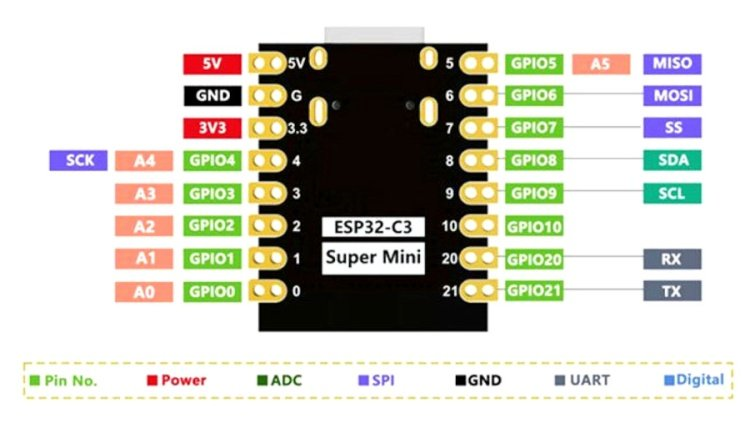
The ESP32 C3 Super Mini Pinout is important for building compact IoT devices, sensor boards, smart home controllers, wireless modules, and small embedded systems. The ESP32 C3 Super Mini uses the ESP32-C3 chip, which supports 2.4 GHz Wi-Fi, Bluetooth LE, GPIO control, I2C, SPI, UART, ADC, PWM, and low-power applications. Espressif documents the ESP32-C3 as a highly configurable chip with GPIO routing through IO MUX and GPIO Matrix, so pin functions can be flexible in software.
What Is ESP32 C3 Super Mini?
The ESP32 C3 Super Mini is a small development board based on the ESP32-C3 microcontroller. It is popular because it offers wireless connectivity, USB-C programming, compact size, and enough pins for many basic projects.
Developers often use it for Wi-Fi sensors, Bluetooth LE devices, smart switches, mini dashboards, battery-powered monitors, home automation nodes, and custom PCB prototypes.
ESP32 C3 Pinout Overview
The ESP32 C3 Pinout includes power pins, ground pins, digital GPIO pins, ADC-capable pins, serial pins, I2C pins, SPI pins, and boot-related pins. The exact layout may vary by board supplier, so users should always compare the printed labels on the board with the supplier diagram.
Common pin groups include:
- 5V Pin For USB Or External Power Input
- 3.3V Pin For Low-Power Modules And Sensors
- GND Pins For Common Ground Connection
- GPIO Pins For Digital Input And Output
- ADC Pins For Analog Sensor Reading
- UART Pins For Serial Communication
- I2C Pins For Sensor Modules
- SPI Pins For Displays, Memory, And Fast Devices
ESP32C3 Datasheet And Pin Function
The ESP32C3 Datasheet shows that ESP32-C3 GPIO pins can support multiple functions through software configuration. This makes the chip flexible for embedded design, but it also means users should not treat every board diagram as fixed forever. The official GPIO documentation states that ESP32-C3 has GPIO0 To GPIO21, and peripheral signals can be routed through GPIO Matrix and IO MUX.
For SEO and technical content, terms like ESP32C3 Datasheet, ESP32 C3 GPIO Reference, ESP32 C3 Pin Mapping, ESP32 C3 Board Pinout, and ESP32 C3 Development Board Pins are all useful when explaining board design.
ESP32 C3 SDA SCL Pins
The ESP32 C3 SDA SCL pins are used for I2C communication. I2C allows the board to connect with OLED displays, temperature sensors, humidity sensors, pressure sensors, RTC modules, IO expanders, and other low-speed devices.
ESP32-C3 I2C is flexible because software can assign I2C signals to suitable GPIO pins. Espressif’s I2C documentation also states that ESP32-C3 supports Standard-Mode And Fast-Mode I2C, with master SCL frequency up to 400 kHz.
For many projects, developers can define custom ESP32 C3 SDA SCL pins in Arduino IDE, ESP-IDF, PlatformIO, or MicroPython. However, it is better to avoid boot-sensitive pins when designing a stable product.
Best Pins For I2C Sensors
For a simple sensor project, choose two stable GPIO pins for SDA and SCL. Add pull-up resistors if the sensor board does not already include them. Keep the wire length short to reduce noise and improve signal stability.
Common I2C project examples include:
- ESP32 C3 I2C OLED Display
- ESP32 C3 BME280 Sensor
- ESP32 C3 Temperature Sensor
- ESP32 C3 RTC Module
- ESP32 C3 I2C LCD Display
- ESP32 C3 Multiple I2C Devices
Power Pins On ESP32 C3 Super Mini
The ESP32 C3 Super Mini usually includes 5V, 3.3V, and GND pins. The 5V pin can often receive power from USB or an external source. The 3.3V pin powers low-voltage sensors and small modules.
Most ESP32-C3 GPIO pins work at 3.3V logic. Do not connect 5V signals directly to GPIO pins unless you use a proper level shifter. This is important for protecting the chip during real product testing.
GPIO Pins For Digital Input And Output
The ESP32 C3 Mini Pinout gives users access to several GPIO pins for buttons, LEDs, relays, buzzers, MOSFET control, and signal input. These pins can read HIGH Or LOW signals and control external devices.
Useful project terms include ESP32 C3 GPIO Output, ESP32 C3 Button Input, ESP32 C3 LED Control, ESP32 C3 Relay Module, and ESP32 C3 Digital Sensor Wiring.
ADC Pins For Analog Sensors
Some ESP32-C3 pins support ADC input. These pins can read analog signals from sensors such as soil moisture sensors, light sensors, battery voltage dividers, pressure sensors, and adjustable potentiometers.
For better accuracy, keep analog wiring short, use stable power, and avoid noisy loads near the ADC input. For product design, always confirm ADC availability in the ESP32C3 Datasheet and the actual board pinout.
UART Pins For Serial Communication
UART pins allow the ESP32 C3 Super Mini to communicate with GPS modules, serial sensors, RS485 converters, debugging tools, and other microcontrollers. Many projects use UART for data logging, firmware testing, and external module communication.
Long-tail search terms include ESP32 C3 UART Pins, ESP32 C3 Serial Communication, ESP32 C3 GPS Module Wiring, and ESP32 C3 RS485 Project.
SPI Pins For Displays And Fast Modules
SPI communication is useful for TFT displays, flash memory, SD card modules, LoRa modules, and high-speed sensors. The ESP32 C3 Pinout can route SPI functions through suitable GPIO pins, but board layout and library settings must match.
For stable SPI design, use short wires, proper grounding, and correct voltage levels. This helps avoid display flicker, data errors, and unstable module communication.
Boot And Strapping Pin Notes
Some ESP32-C3 pins affect boot mode during startup. If these pins connect to external circuits with the wrong pull-up or pull-down state, the board may fail to boot or upload code.
For reliable projects, avoid using boot-sensitive pins for circuits that force a fixed level during reset. This is especially important for relays, motor drivers, sensors with strong pull resistors, and external modules.
Common ESP32 C3 Super Mini Projects
The ESP32 C3 Super Mini Pinout is suitable for many compact projects, including:
- Wi-Fi Temperature And Humidity Monitor
- Bluetooth LE Sensor Beacon
- Smart Light Controller
- Mini Web Server
- Home Automation Switch
- Wireless Soil Moisture Sensor
- ESP32 C3 OLED Display Project
- Battery Voltage Monitor
- Smart Door Sensor
- Compact IoT Data Logger
ESP32 C3 Super Mini Vs Standard ESP32 Boards
The ESP32 C3 Super Mini is smaller than many standard ESP32 development boards. It is better for compact devices, portable products, and custom PCB testing. However, it exposes fewer pins, so users must plan pin usage carefully.
A larger ESP32 board may offer more GPIO pins, more ADC channels, and more expansion space. A mini board is better when size, low cost, and simple wireless control matter more.
How To Choose Pins For A Stable Project
Choose pins based on communication type, boot behavior, voltage level, and physical layout. Use I2C for simple sensors, SPI for faster displays or memory, UART for serial modules, and GPIO for buttons or control signals.
Before final PCB design, test the same pin setup on the real board. Also check the ESP32C3 Datasheet, board silkscreen, supplier pinout, and firmware library settings.
Conclusion
The ESP32 C3 Super Mini Pinout gives developers a compact and flexible platform for IoT projects, sensor systems, wireless controllers, and small embedded products. By understanding ESP32 C3 Mini Pinout, ESP32 C3 Pinout, ESP32 C3 SDA SCL, GPIO functions, power pins, ADC input, UART, and SPI options, users can build more reliable ESP32-C3 projects.
For stable development, always confirm the board layout, check the ESP32C3 Datasheet, avoid risky boot-pin connections, and match the firmware pin settings with the actual hardware.