What Is Aluminum PCB?
Definition Of Aluminum PCB
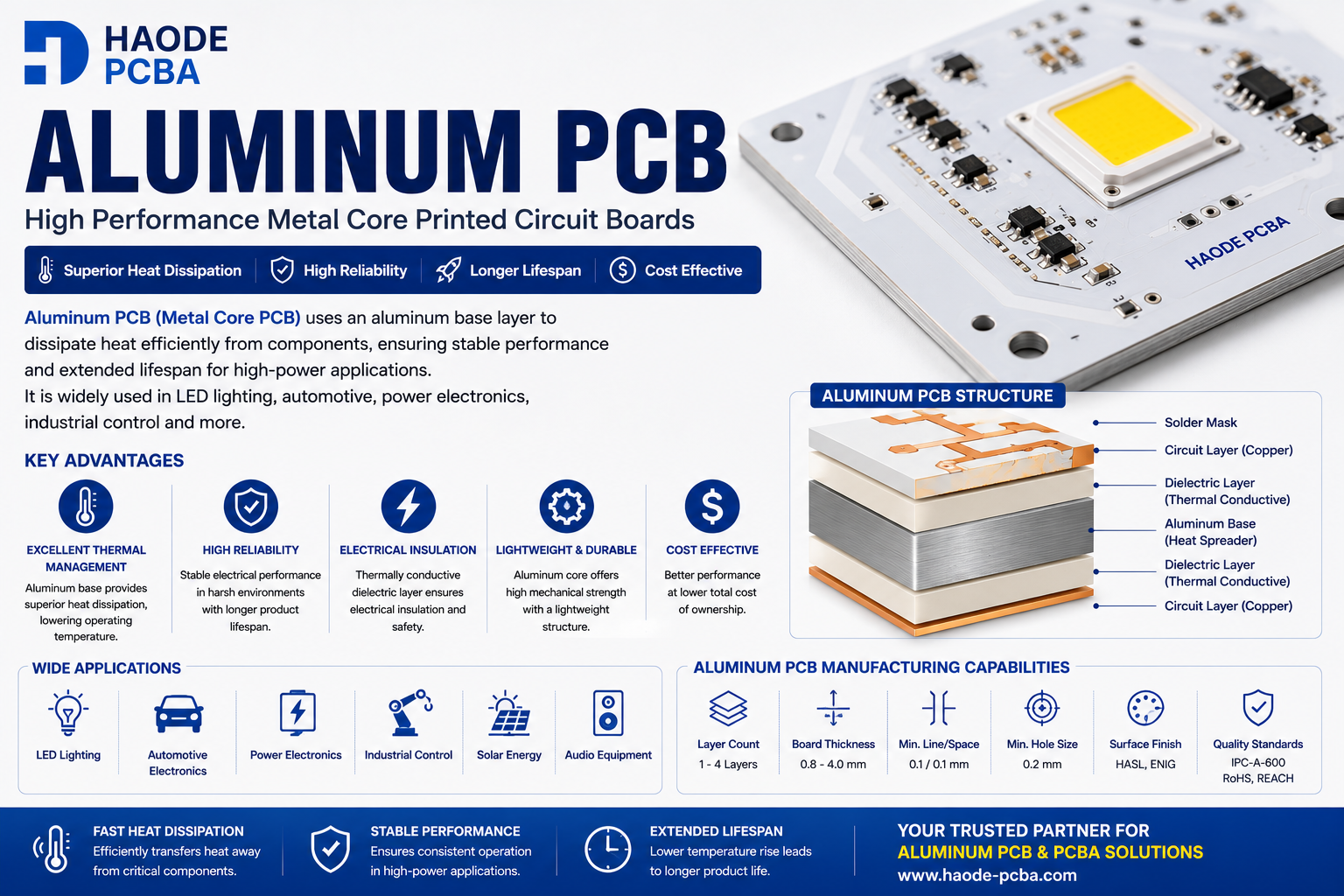
Aluminum PCB is a type of metal core printed circuit board that uses an aluminum substrate to improve heat dissipation and mechanical performance.
Unlike traditional FR4 PCBs, which mainly rely on fiberglass and epoxy materials, aluminum PCBs use a metal base layer that transfers heat away from electronic components more efficiently.
A typical aluminum PCB structure includes:
- Copper Circuit Layer
- Dielectric Insulation Layer
- Aluminum Metal Base Layer
This structure allows aluminum PCBs to provide excellent thermal management for high-power electronic applications.
Why Aluminum PCB Is Important For Thermal Management
Heat management has become one of the biggest challenges in modern electronics.
Excessive heat can cause:
- Reduced component lifespan
- Lower system reliability
- Performance degradation
- Electronic failures
Aluminum PCB technology helps solve these problems by providing a direct thermal pathway from components to the metal substrate.
This makes aluminum PCBs especially suitable for applications requiring:
- High power output
- Continuous operation
- Compact design
- Reliable thermal performance
Aluminum PCB Structure And Materials
Copper Circuit Layer
The copper layer provides electrical connections between electronic components.
Common copper thickness options include:
- 1 oz copper
- 2 oz copper
- Heavy copper designs
The required copper thickness depends on:
- Current requirements
- Thermal performance
- Application environment
Dielectric Insulation Layer
The dielectric layer separates the copper circuit from the aluminum base.
Its main functions include:
- Electrical insulation
- Heat transfer
- Mechanical bonding
A high-quality dielectric layer provides:
- Low thermal resistance
- High breakdown voltage
- Long-term reliability
Aluminum Metal Base Layer
The aluminum layer provides mechanical support and heat dissipation.
Advantages include:
- Excellent thermal conductivity
- Lightweight structure
- Corrosion resistance
- Mechanical strength
Common aluminum materials include:
- Aluminum 5052
- Aluminum 6061
Aluminum PCB Vs FR4 PCB
Thermal Performance Comparison
The biggest difference between aluminum PCB and FR4 PCB is heat dissipation.
FR4 PCB has limited thermal conductivity because fiberglass materials do not transfer heat efficiently.
Aluminum PCB provides:
- Faster heat transfer
- Better temperature control
- Improved component reliability
Application Comparison
FR4 PCB is commonly used for:
- Consumer electronics
- Control systems
- General electronic products
Aluminum PCB is widely used for:
- LED lighting
- Power electronics
- Automotive lighting
- Industrial equipment
Cost Comparison
Aluminum PCB usually costs more than standard FR4 because of:
- Metal substrate materials
- Thermal design requirements
- Specialized manufacturing processes
However, improved thermal performance can reduce long-term maintenance costs.
Aluminum PCB Manufacturing Process
Engineering Review And DFM Analysis
Before production, engineers evaluate:
- Thermal requirements
- Layer structure
- Copper thickness
- Mechanical requirements
A professional DFM review helps optimize:
- Manufacturing efficiency
- Product reliability
- Production cost
Circuit Pattern Manufacturing
The copper circuit layer is produced through:
- Imaging
- Etching
- Cleaning
High precision is required to maintain:
- Trace accuracy
- Electrical performance
Dielectric Lamination
The dielectric layer is bonded between:
- Copper circuit
- Aluminum substrate
This process requires accurate control of:
- Temperature
- Pressure
- Material alignment
Drilling And Surface Finishing
Depending on design requirements, aluminum PCBs may include:
- Through holes
- Plated holes
- Surface finishing
Common surface finishes include:
- ENIG
- HASL
- OSP
Aluminum PCB Applications
LED Lighting Applications
LED lighting is one of the largest applications for aluminum PCB technology.
Examples include:
- LED bulbs
- Street lighting
- Industrial lighting
- Automotive LED systems
The aluminum substrate helps remove heat generated by high-power LEDs.
Automotive Electronics
Modern vehicles require reliable thermal management.
Aluminum PCBs are used in:
- LED headlights
- Battery systems
- Power control modules
- Electric vehicle electronics
Power Electronics
Applications include:
- Power converters
- Motor controllers
- Switching power supplies
High thermal conductivity improves system stability.
Industrial Equipment
Industrial products often require:
- Long operating time
- High reliability
- Effective heat dissipation
Aluminum PCBs support these requirements.
Aluminum PCB Thermal Performance
Thermal Conductivity
Thermal conductivity is a key parameter for aluminum PCB selection.
Higher thermal conductivity provides:
- Better heat transfer
- Lower operating temperature
- Improved reliability
Heat Dissipation Design
Engineers should consider:
- Component placement
- Copper area
- Thermal vias
- Metal substrate thickness
Optimized thermal design improves overall system performance.
Aluminum PCB Quality Standards
IPC Standards For Aluminum PCB Manufacturing
Professional aluminum PCBA manufacturing follows industry quality requirements established by organizations such as IPC.
IPC provides standards related to:
- PCB fabrication quality
- Material requirements
- Assembly reliability
Following recognized standards helps manufacturers maintain consistent production quality.
Material Selection And Reliability
Aluminum PCBA performance depends heavily on material quality.
Manufacturers should evaluate:
- Aluminum substrate quality
- Dielectric performance
- Copper bonding reliability
For advanced PCB materials, suppliers such as Rogers provide specialized high-performance laminates used in demanding electronic applications.
How To Choose An Aluminum PCB Manufacturer
Manufacturing Capability
A reliable Aluminum PCBA Manufacturer should have experience with:
- Metal core PCB production
- Thermal management design
- High-power applications
- Quality testing
Engineering Support
Professional support should include:
- Thermal analysis
- DFM optimization
- Material recommendation
- Production improvement
PCB Assembly Capability
Choosing a manufacturer with PCB assembly capability provides advantages:
- One-stop production
- Better quality control
- Faster communication
Haode PCBA provides PCB fabrication and assembly services to support customers from prototype development to mass production.
Why Choose Haode PCBA For Aluminum PCB Manufacturing?
Haode PCBA provides professional Aluminum PCB Manufacturing And PCB Assembly Services for global customers.
Our capabilities include:
- Aluminum PCB fabrication
- Metal Core PCB production
- LED PCB solutions
- SMT assembly
- Component sourcing
- Prototype manufacturing
- Mass production
- Quality inspection
With engineering experience and manufacturing expertise, Haode PCBA helps customers develop reliable thermal management PCB solutions.
Conclusion
Aluminum PCBA technology provides an effective solution for electronic products requiring excellent heat dissipation and high reliability.
Compared with traditional FR4 PCBs, aluminum PCBs offer superior thermal performance, making them ideal for LED lighting, automotive electronics, power systems, and industrial applications.
Choosing an experienced Aluminum PCB Manufacturer helps ensure better thermal design, manufacturing quality, and long-term product reliability.